A criminal record does not automatically disqualify you from a California dealer license, but some convictions come close. Vehicle Code §11703(d) lets DMV refuse a license for a conviction "substantially related" to dealer work. DMV's own guidelines say the most serious category, which includes most vehicle and financial crimes, should almost always lead to denial if the conviction is less than five years old. Older convictions, and less serious ones, are judged case by case.
This page is general information, not legal advice. Criminal history and licensing are legal matters. If you have a conviction, talk to an attorney before you apply, and answer every DMV question truthfully. DMV makes every licensing decision.
What the law says
Vehicle Code §11703 lists the grounds on which DMV may refuse a dealer license. The ones that matter here:
- §11703(d): a conviction, or an act involving moral turpitude, that is substantially related to the qualifications, functions or duties of a dealer. A plea of nolo contendere (no contest) counts as a conviction.
- §11703(f): an application that contains incorrect information. Leaving a conviction off your application is a separate reason to refuse, on top of the conviction itself.
- §11703(a)–(c), (e), (h): prior dealer or occupational licenses that were revoked or suspended, in California or another state, including businesses you managed or represented.
"May refuse" means DMV has discretion. How it uses that discretion is set out in its Occupational Licensing and Disciplinary Guidelines.
How DMV weighs a conviction
DMV's guidelines sort convictions into three classes and look at how long ago they happened. The time periods run back from the date you apply, not the date of the conviction, and time spent incarcerated doesn't count toward rehabilitation.
| Class | What it covers | Less than the window | Beyond the window |
|---|---|---|---|
| Class A | Serious crimes involving moral turpitude with a substantial connection to dealer duties | Within 5 years: should almost always result in outright denial | Over 5 years: no automatic denial; DMV weighs rehabilitation |
| Class B | Less serious moral-turpitude crimes with a substantial connection | Within 3 years: case-by-case; DMV looks at the facts and whether the sentence was fully completed | Over 3 years: focus on rehabilitation |
| Class C | Crimes with a weaker connection to dealer duties | Within 3 years: case-by-case | Over 3 years: reviewed with care |
A few more rules from the guidelines:
- Expungement helps but doesn't erase it. A Class A conviction dismissed under Penal Code §1203.4 is treated like a Class B.
- Multiple convictions are judged as a pattern. One conviction that would normally lead to denial is enough.
- Prior discipline counts. A previous license revocation is weighed like a Class A conviction.
Examples of how convictions are classed
From DMV's guidelines. This is not the full list.
| Conviction | Code section | Class |
|---|---|---|
| Taking a vehicle without the owner's consent | Vehicle Code §10851 | A |
| Forging or altering a vehicle registration | Vehicle Code §4463 | A |
| Odometer tampering | Vehicle Code §28051 | A |
| False vehicle theft report | Vehicle Code §10501 | A |
| False information on DMV or CHP documents | Vehicle Code §20 | A or B |
| Tampering with a vehicle | Vehicle Code §10852 | B |
| Taking a vehicle for temporary use | Penal Code §499 | B |
| Forgery | Penal Code §470 | A |
| Grand theft | Penal Code §487 | A |
| Embezzlement | Penal Code §503 | A |
| Identity theft | Penal Code §530.5 | A |
| Bad checks | Penal Code §476 | B (may be A) |
| False financial statement | Penal Code §532 | B (may be A) |
| Petty theft | Penal Code §488 | B |
What you must disclose
The dealer application's personal history questions (form OL 29B) ask about:
- Every felony and misdemeanor conviction in the last 10 years, in any state or country, including convictions where you were on probation or released from custody in that period. Traffic offenses are excluded.
- Expunged, pardoned and no-contest convictions. A conviction set aside under Penal Code §1203.4 must still be disclosed.
- Pleas or verdicts awaiting sentencing, and pending criminal charges, with the court and case number.
- One narrow exception: certain cannabis convictions under Health and Safety Code §§11357(b)–(e) and 11360(b) need not be disclosed if they are more than two years old.
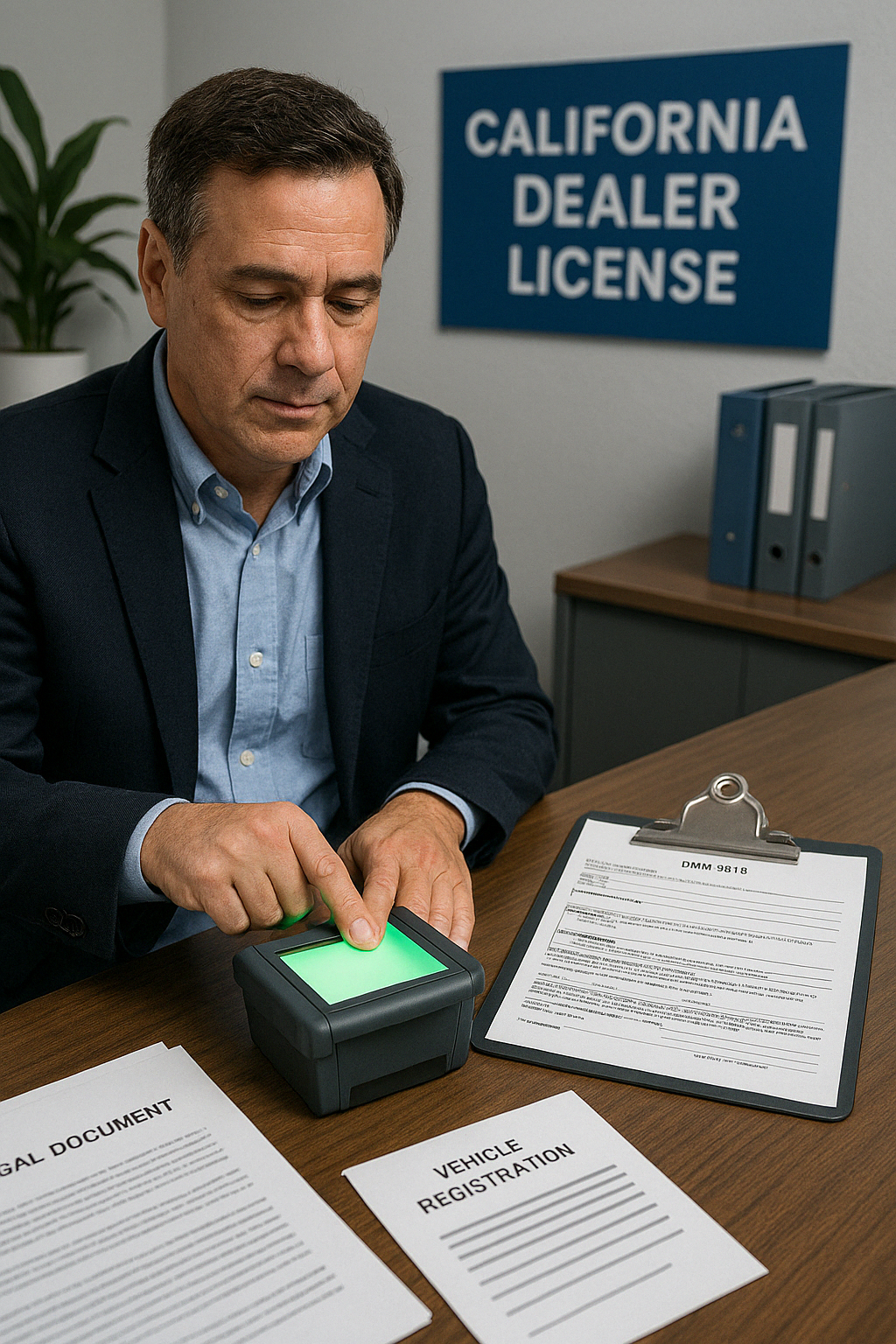
You sign the application under penalty of perjury. DMV runs your Live Scan fingerprints through state and federal records, so an omitted conviction will surface. Under DMV's guidelines, failing to disclose a recent conviction should by itself result in denial, and an incorrect application is its own ground for refusal under §11703(f).
What DMV looks at for rehabilitation
DMV's guidelines list six factors:
- The nature and severity of the conviction
- Your full criminal record and conduct since
- Time elapsed, not counting time incarcerated
- Whether you completed parole, probation, restitution and any other sanctions
- Whether the conviction was expunged under Penal Code §1203.4
- Evidence of rehabilitation you submit
Useful documents to gather before you apply: certified court records, proof that probation and restitution were completed, any expungement order, and letters from employers or others who can speak to your conduct since.
From experience
Instructor note from Garrett Eddings (professional opinion, not legal advice): I've had students with records get approved, but typically the conviction was more than five years old. In my experience, crimes tied to vehicles or money (theft, fraud, forgery and similar) have always been a struggle, and I've seen them lead to denial. That lines up with DMV's guidelines, which put most of those crimes in Class A. If that's your situation, talk to an attorney before you pay for anything else.
Steps if you have a conviction
- Get your records. Pull certified court records for every conviction in the last 10 years so your answers match exactly.
- Talk to an attorney if any conviction is vehicle-related, financial, recent, or a felony. An attorney can also tell you whether expungement is an option first.
- Disclose everything on the application, including expunged and out-of-state convictions.
- Complete Live Scan for every owner listed on the application.
- Include your rehabilitation evidence with the application rather than waiting to be asked.
- If you're denied, you can demand a hearing in writing within 60 days of the refusal notice under Vehicle Code §11708; the hearing follows the state Administrative Procedure Act (Government Code §11500 and following). Read Application Denied: Reasons and Appeals for what comes next.
Related: How to get a California dealer license · Dealer license cost · DMV forms for dealers · Pre-licensing course
Frequently asked questions
Can you get a dealer license with a felony in California?
Sometimes. A felony doesn't automatically disqualify you, but DMV can refuse a license for a conviction substantially related to dealer work. DMV's guidelines say serious, related convictions within five years should almost always be denied; older ones are weighed against rehabilitation.
How far back does DMV look?
The application asks about convictions in the last 10 years, including any probation or release from custody in that period. DMV's guidelines use 5-year and 3-year windows, counted back from the application date, when deciding how much weight a conviction gets.
Do I have to disclose an expunged conviction?
Yes. Convictions set aside under Penal Code §1203.4, pardoned convictions and no-contest pleas must all be disclosed.
Do I have to disclose a DUI?
The dealer application excludes traffic offenses. Whether a particular DUI counts as a traffic offense can depend on the charge; if you're unsure, disclose it or ask an attorney.
What happens if I leave a conviction off my application?
DMV will find it through Live Scan. An incorrect application is its own ground for refusal under Vehicle Code §11703(f), and DMV's guidelines treat non-disclosure of a recent conviction as reason to deny.
Sources: California Vehicle Code §11703 · Vehicle Code §11708 · DMV Occupational Licensing and Disciplinary Guidelines (Rev. 4/2010) · DMV form OL 29B, Application for Occupational License (Rev. 1/2019) · DMV: Vehicle Dealer License. Verified 2026-10-16.
California Dealer Academy is an education provider, not a law firm. This page is general information, not legal advice, and it doesn't predict how DMV will decide any application. Laws, forms and DMV practices change. For advice about your record, consult a licensed California attorney. The instructor note reflects one instructor's professional experience and opinion.
We Can Help You Get Licensed
California Dealer Academy offers end-to-end assistance — from education to DMV application prep. Our DMV-approved course gets you certified and ready to get your license.
Enroll Now