Part 1 Video: Federal and State Form Requirements
Part 1 Reading: Federal and State Form Requirements
Used Car Rule
The Used Motor Vehicle Trade Regulation Rule is a federal rule issued by the Federal Trade Commission (FTC) in 1984 that sets requirements for used car dealerships in the United States. The rule is aimed at preventing deceptive and unfair practices in the sale of used motor vehicles and applies to all used car dealerships, including those in California.
The Used Motor Vehicle Trade Regulation Rule requires used car dealers to display a “Buyers Guide” on each used car that they offer for sale. This guide provides information about the vehicle, including whether it comes with a warranty and what types of defects are covered. It also includes information about the dealer’s return policy and the terms of any warranty offered.
The rule also requires dealers to disclose certain information about the vehicle’s history, including whether it was previously used as a rental car or a taxi, and whether it has been in any accidents or had any major repairs. Dealers are also required to provide consumers with a copy of any warranty offered and to obtain a signed acknowledgment of the sale from the buyer.
In California, used car dealerships must comply with both federal and state laws governing the sale of used motor vehicles. The California Department of Motor Vehicles (DMV) has its own set of regulations that dealers must follow, which cover issues such as advertising, sales contracts, and disclosure requirements.
Overall, the Used Motor Vehicle Trade Regulation Rule aims to protect consumers from deceptive and unfair practices in the sale of used motor vehicles and to ensure that the customer has the information they need to make informed purchasing decisions.
Federal Buyers Guide
As a part of the Used Motor Vehicle Trade Regulation Rule of 1984, the definition of the expectations that must be met by a used vehicle dealer were more clearly outlined. This would become what the Federal Trade Commission outlined as the Used Car Rule.
Before a used vehicle is offered for sale, a Buyer’s Guide must be filled in based on the details of the vehicle and the dealer it is offered for sale at. It also needs to be posted on the vehicle so you can clearly see the front and back of the buyer’s guide when looking at the vehicle.
The Federal Trade Commission’s (FTC) Used Car Rule requires used car dealerships to display a “Buyers Guide” on every used car offered for sale. The Buyers Guide must contain the following information:
- The make, model, year, and vehicle identification number (VIN) of the vehicle.
- Whether the vehicle is being sold “as is” or with a warranty.
- The terms of the warranty, if any, including the duration and what systems or components are covered.
- Any systems or components that are known to be defective or that may require repair.
- Whether there are any other types of warranties or service contracts available for purchase.
- The dealer’s name and address, as well as the date the Buyers Guide was printed.
Customers can use the Buyers Guide to get information about the vehicle’s condition and history, the warranty coverage, and any defects that may need repair. The Buyers Guide can also help customers compare different vehicles and dealerships and make more informed purchasing decisions.
In California, used car dealerships must comply with both federal and state laws governing the sale of used motor vehicles. The California Department of Motor Vehicles (DMV) has its own set of regulations that dealers must follow, which cover issues such as advertising, sales contracts, and disclosure requirements.
Under California law, the Buyers Guide must include additional information about the vehicle’s history, including whether it was previously used as a rental car or a taxi, and whether it has been in any accidents or had any major repairs. California also requires dealers to provide a Spanish-language Buyers Guide if the vehicle is sold in a primarily Spanish-speaking area.
Overall, the Buyers Guide is an important tool for customers buying a used car, and dealerships in California and across the United States must comply with the federal Used Car Rule and any applicable state regulations to ensure that customers are fully informed about the vehicles that they are purchasing.

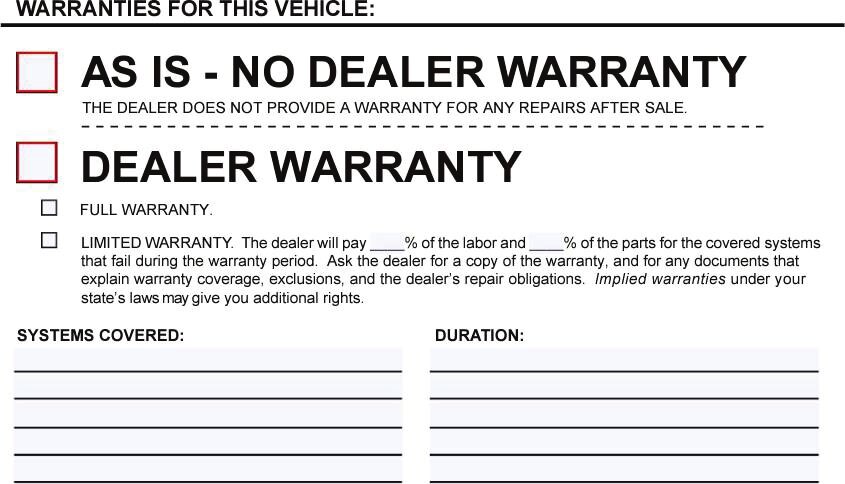
One of the first elements of filling in the Buyers Guide is making sure that the information is correct regarding the year, make, model and vehicle identification number on the vehicle.
There are two separate ways that the next portion can be displayed for your retail customer, but it greatly depends on what kind of a warranty policy you’re going to have at your dealership.
For many dealers who start initially, offering a vehicle As Is – No Dealer Warranty is how most dealers choose to operate. This can prove to be a setback for some retail customers when they look at whatever vehicles are potentially for sale at the dealership lot. Knowing how to overcome some of these objections can be crucial to the success of your sale. Here are some ways to overcome objections to offering vehicles as is:
- Showing/proving your work – Part of division 12 safety requirements are ensuring that the vehicle that is offered to the retail public must ensure that all safety equipment is in proper working condition prior to offering the vehicle for sale.
- One ideal way of doing this is making sure that a mechanic shop has done a safety inspection on the vehicle. By showing a potential customer a copy of the service order that was performed on a vehicle, this will instill confidence with your potential customer and help instill confidence in the potential sale.
- Is the vehicle still under manufacturer’s warranty?
- Manufacturers all have a specific warranty that comes with their vehicle at the time of purchase with the original owner. Some warranties extend for the lifetime of the vehicle, some do not extend to third party consumers – so it’s important to know the vehicle that you are selling and make sure that your customer is aware of the situation that is presented by this as well.
- Example – Hyundai has a 10-year, 100,000-mile powertrain warranty with the original owner. However, once the original owner sells the vehicle, the manufacturer’s warranty goes to a 5-year, 60,000-mile warranty on the powertrain.
- Pro Tip – If a vehicle is outside of manufacturer’s warranty, there is a chance that a franchise store might “Goodwill” the coverage on the warranty depending on the situation. This should not be relied on as a guarantee but can be helpful to ask to see if something can be done.
- Manufacturers all have a specific warranty that comes with their vehicle at the time of purchase with the original owner. Some warranties extend for the lifetime of the vehicle, some do not extend to third party consumers – so it’s important to know the vehicle that you are selling and make sure that your customer is aware of the situation that is presented by this as well.
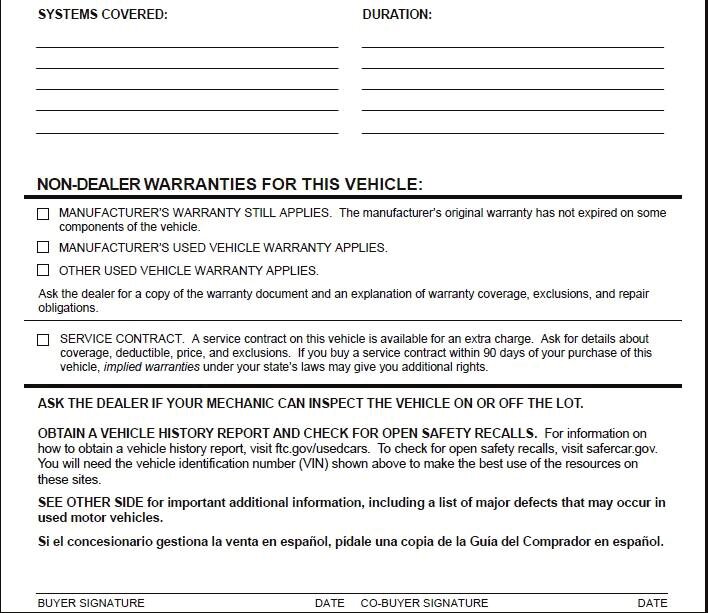
- Vehicle Service Contract – Vehicle service contracts can be an excellent supplement to an “As Is – No Warranty Sale” due to the additional coverage that it adds to consumer confidence. Vehicle service contracts stem from a simple powertrain warranty all the way to near full coverage on any failed component on a vehicle. It is also important to understand the difference between a warranty and a service contract. Warranties are provided directly from a dealer or manufacturer, whereas a service contract is a third-party agreement that is handled directly between a mechanic shop and the service contract provider.
- Note – Make sure before you offer a vehicle service contract that you understand the level of coverage that a service contract provider offers. Make sure you read the fine print! One example of this coverage extends to “internal lubricated parts”. Many do not cover “reasonable wear and tear” on certain vehicle items such as:
- Tires
- Brakes
- Wiper blades
- Rotors
- Etc.
- Pro Tip – NEVER indicate that a vehicle service contract is “Full Coverage”. Most, if not all, service contract providers have limitations on what is covered on a vehicle and telling your customer that they have full coverage on their service contract runs the risk of not setting proper expectations with your client. Rather than saying it’s fully covered, try using the number of components that the service contract covers.
- “Our gold package offers 750 individualized parts that covers your vehicle for the next 5 years, 100,000 miles.”
- Note – Make sure before you offer a vehicle service contract that you understand the level of coverage that a service contract provider offers. Make sure you read the fine print! One example of this coverage extends to “internal lubricated parts”. Many do not cover “reasonable wear and tear” on certain vehicle items such as:
If a warranty is offered by your dealership, the dealership should be extremely detailed when it comes to what is covered and outline exactly what on the vehicle are the covered items. There are two types of warranties that can be offered. Either full or limited:
- Full warranty – If the vehicle is a full warranty, then it must have all the following:
- The warranty service and claims are open to anyone that owns the vehicle if the warranty time is still valid.
- Warranty services are always free of charge regardless of the circumstances.
- Customers must be given the option to either be able to repair or replace any damaged item or if the item in question cannot be properly addressed within a certain number of requests.
- Customers are not required to do anything beyond letting the dealer know that the service is needed. Once notification happens, the service needs to be performed unless it can be determined that it is reasonable that a customer needs to do more than just simply give notice.
- The warranty cannot be limited in any way.
It’s because of these parameters that most warranties are considered limited. A warranty operates on the basis of giving the selling dealer the opportunity to decide what they want to cover. It is important for dealers to outline specifically what percentage of the labor will be covered and what percentage of the parts will be covered as well.
There are certain circumstances where a deductible may come into play, therefore putting an * next to the number and provide a detailed explanation under the column that outlines the Systems Covered and Duration section:
“A $100 deductible is required for each service appointment.”
Listed on the Buyers Guide are two separate columns that outline what systems are covered and how long the warranty is for those items. It’s important to also note if the vehicle is still under the manufacturer’s warranty or if it’s a dealer-covered item.
Service Contracts
It is required that a dealer lists on the buyer’s guide if a service contract is going to be offered. That is why it’s important as a dealer to understand what is included in a service contract, how they are used, and what benefit they can provide for both the dealer and the customer.
Vehicle service contracts (VSC), also known as extended warranties or service agreements, are contracts that provide additional coverage for repair or replacement of certain components or systems on a vehicle. These contracts are typically sold by dealerships or third-party providers and are designed to provide customers with added peace of mind and protection from unexpected repair costs.
Pros of purchasing a vehicle service contract include:
- Protection from unexpected repair costs: A VSC can cover repair or replacement costs for certain components or systems that are not covered by the manufacturer’s warranty, which can help protect customers from unexpected and potentially costly repairs.
- Peace of mind: Knowing that certain repairs or replacements are covered under a VSC can provide customers with added peace of mind and reduce the stress and anxiety associated with unexpected repairs.
- Transferable: In some cases, VSC’s can be transferred to a new owner if the vehicle is sold, which can add value to the vehicle and make it more attractive to potential buyers.
Cons of purchasing a vehicle service contract include:
- Cost: VSC’s can be expensive, and customers may end up paying more for the contract than they would for the repairs themselves.
- Limited coverage: VSC’s may not cover all repairs or replacements, and there may be exclusions or limitations that customers should be aware of before purchasing.
- Claims process: Filing a claim under a VSC can be a complex process, and customers may need to meet certain requirements or provide documentation to have the repair or replacement covered.
In California, dealerships can offer VSC’s to customers to provide additional protection and peace of mind. California law requires dealerships to disclose certain information about VSCs to customers, including the cost of the contract, the coverage provided, and any deductibles or exclusions.
Examples of companies that sell service contracts for car dealers include Ally, Zurich, and CNA National Warranty Corporation. These companies offer a range of VSC options for dealerships to offer to customers, with varying levels of coverage and pricing. It is important for customers to research and compare different VSC options and providers to find the best fit for their needs and budget.
Vehicle History Reports
The last portion that needs to be signed off by the customer is the vehicle history report. There is one report that is required which is the NMVTIS report or the National Motor Vehicle Title Information System. The other two that are suggested are Carfax and Autocheck. Let’s learn how each of these can be used.
The National Motor Vehicle Title Information System (NMVTIS) is a federal database that provides information on the history of motor vehicles in the United States. The database contains data from state motor vehicle agencies, insurance companies, salvage yards, and other sources, and it is intended to help prevent vehicle-related fraud and theft.
NMVTIS was established by the Anti-Car Theft Act of 1992, and it became fully operational in 2009. It is overseen by the Department of Justice and managed by the American Association of Motor Vehicle Administrators (AAMVA).
When buying a car, an NMVTIS report can be used to provide information on the vehicle’s history, including:
- Title information: The report can show whether the vehicle has a clean title, a salvage title, or has been reported as stolen.
- Odometer readings: The report can provide information on the vehicle’s odometer readings, which can help to identify potential fraud or odometer tampering.
- Accident history: The report can provide information on any reported accidents or damage to the vehicle.
- Previous owners: The report can show how many previous owners the vehicle has had, which can be helpful in determining its overall condition and history.
The NMVTIS report can be purchased from authorized providers, and the cost varies depending on the provider and the level of detail included in the report.
The NMVTIS report gets its data from a variety of sources, including state motor vehicle agencies, insurance companies, salvage yards, and auto recyclers. By collecting and analyzing this data, NMVTIS helps to prevent vehicle-related fraud and theft, and it provides valuable information to consumers who are considering purchasing a used car.
Here is a little bit of the history on the company.
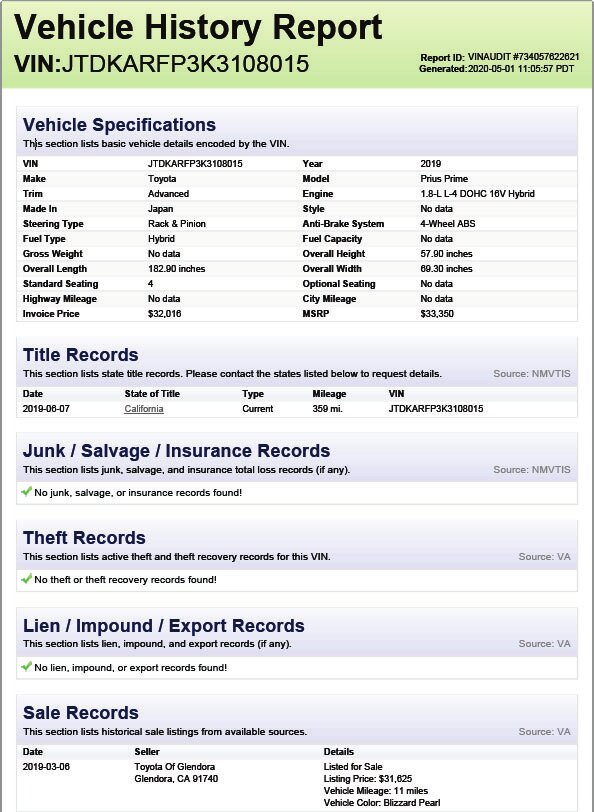
VinAudit.com is a web-based service that provides vehicle history reports to consumers who are considering purchasing a used car. The service is designed to help consumers make informed decisions about the vehicles they are interested in, by providing detailed information on the vehicle’s history, including accident history, title information, and other important details.
VinAudit.com uses data from a variety of sources, including the National Motor Vehicle Title Information System (NMVTIS), which is a federal database that collects information on the history of motor vehicles in the United States. By collecting and analyzing this data, VinAudit.com provides consumers with a comprehensive view of the vehicle’s history, which can help them to identify potential problems or issues before making a purchase.
To use VinAudit.com, consumers simply enter the vehicle identification number (VIN) of the car they are interested in, and the system generates a detailed report that includes information on the vehicle’s title history, accident history, odometer readings, and other important details. The report also includes a score that indicates the overall health of the vehicle based on its history, as well as a recommended retail value based on current market conditions.
VinAudit.com offers a range of pricing options, from a single report to a monthly subscription, depending on the needs of the consumer. The service is widely used by consumers who are considering purchasing a used car, as well as by car dealerships and other businesses that need to access vehicle history information on a regular basis.
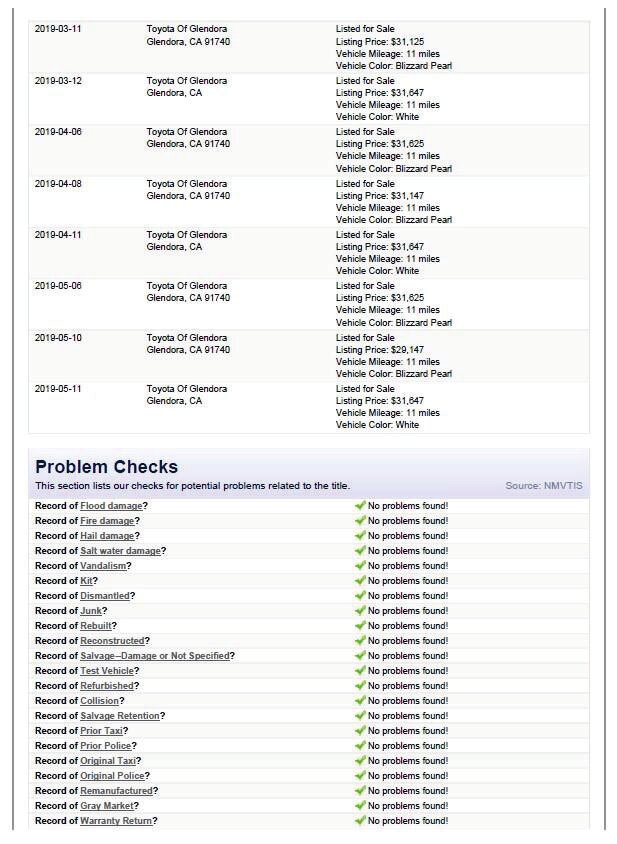
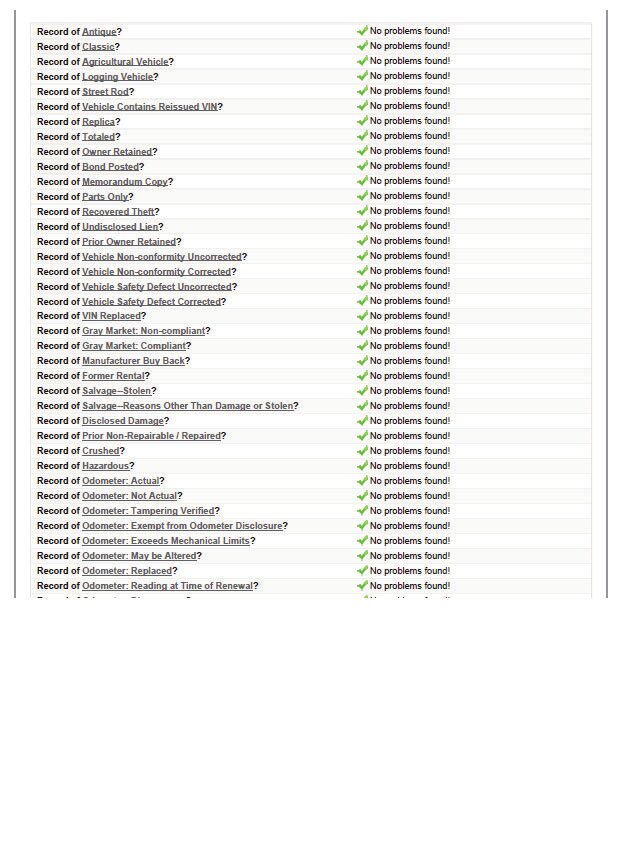
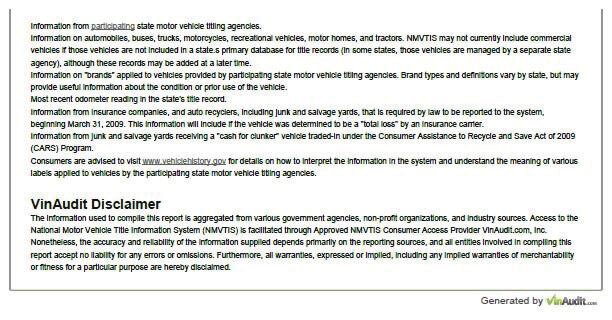
On the following pages, here is an example of what an NMVTIS Report looks like:
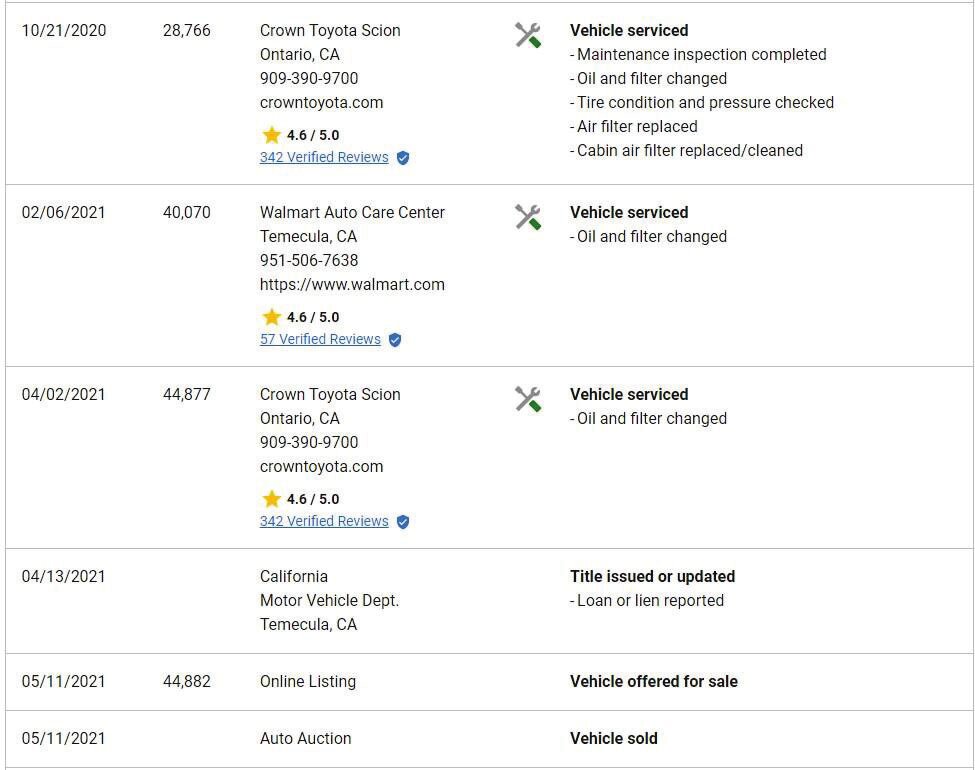
Carfax
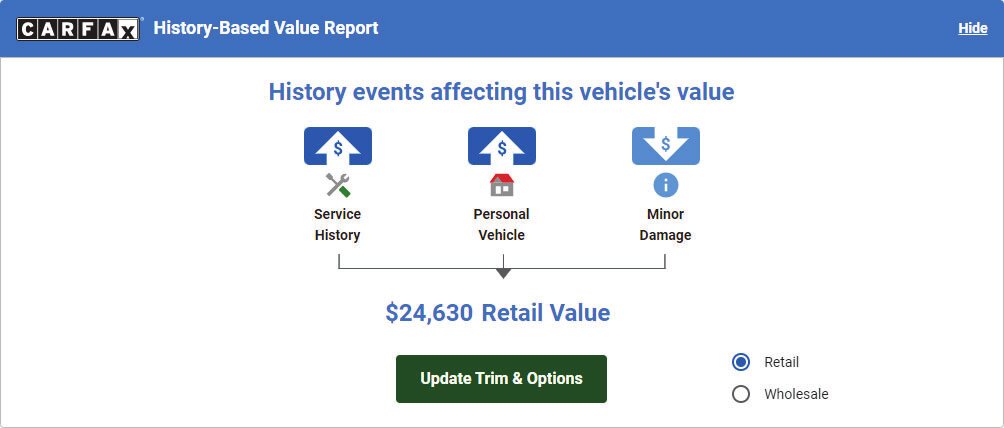
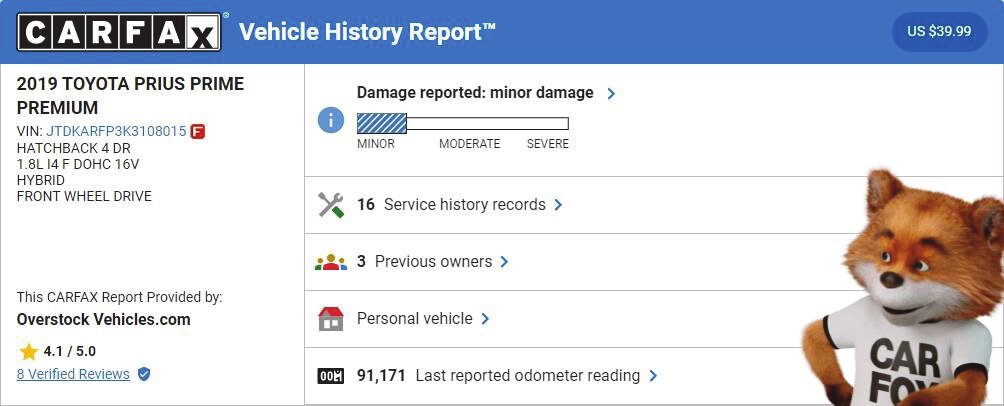
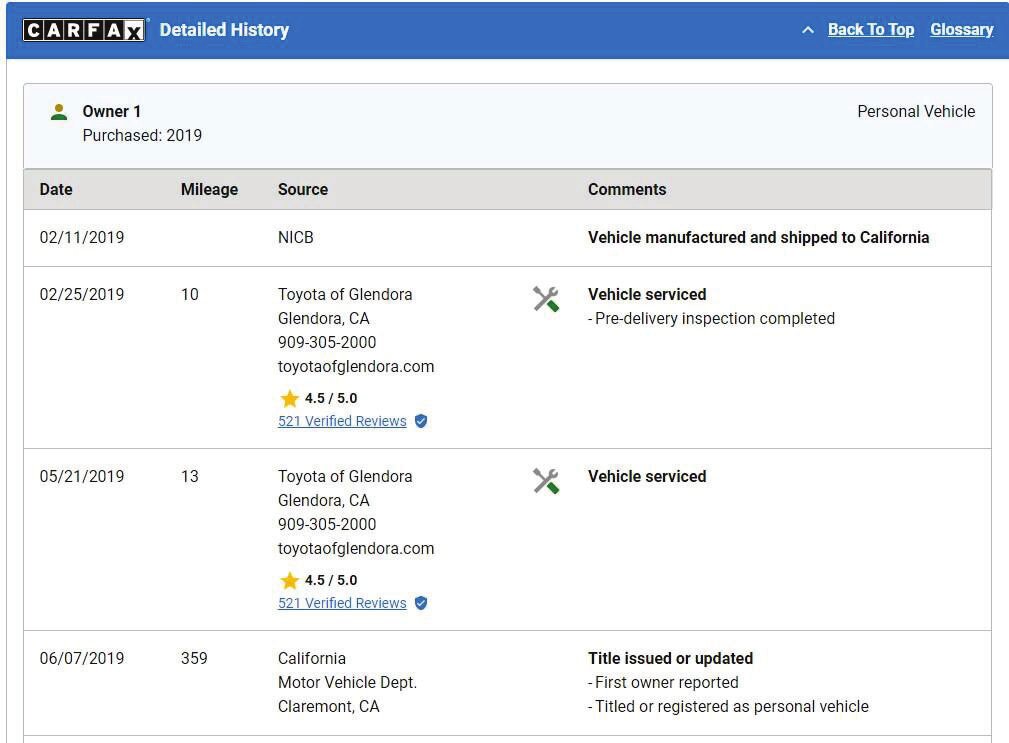
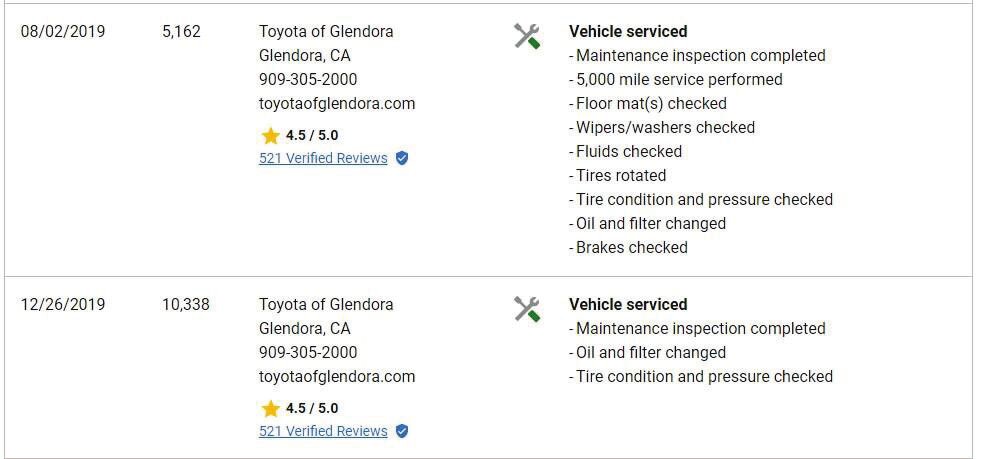
Carfax is a web-based service that provides vehicle history reports to consumers who are considering purchasing a used car. The company was founded in 1984 and is based in Centreville, Virginia.
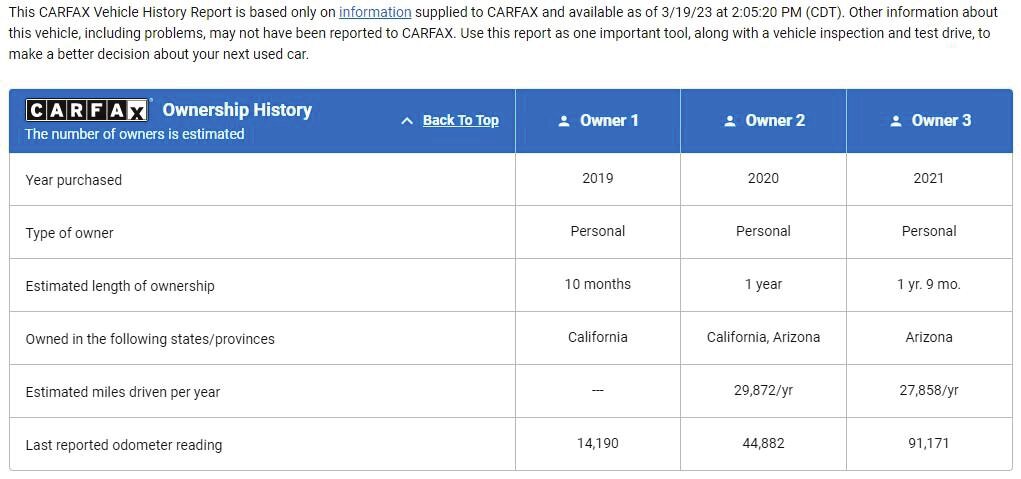
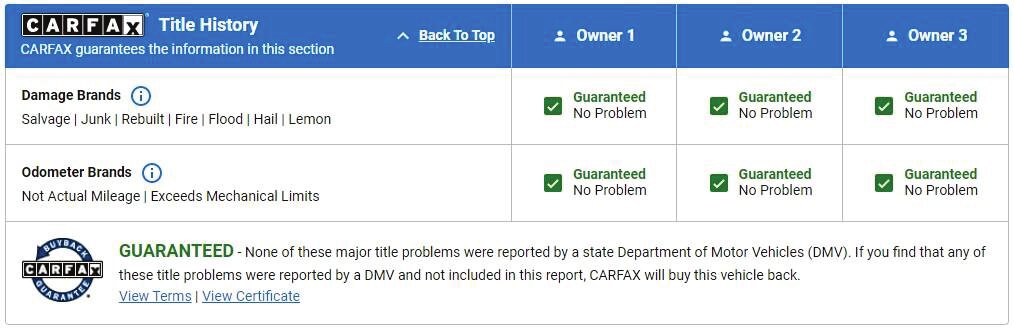
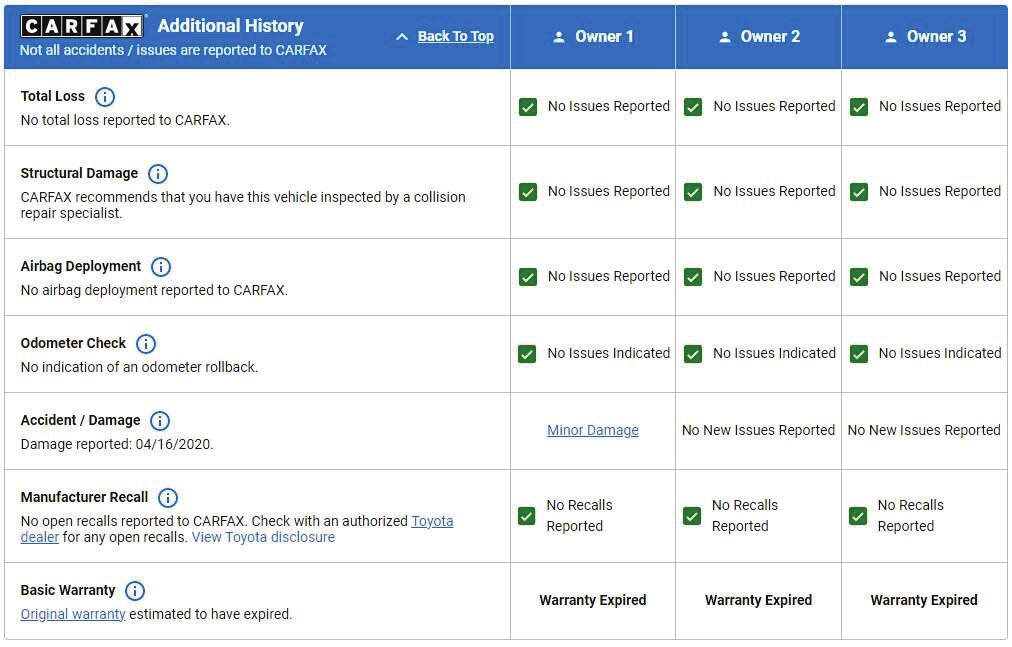
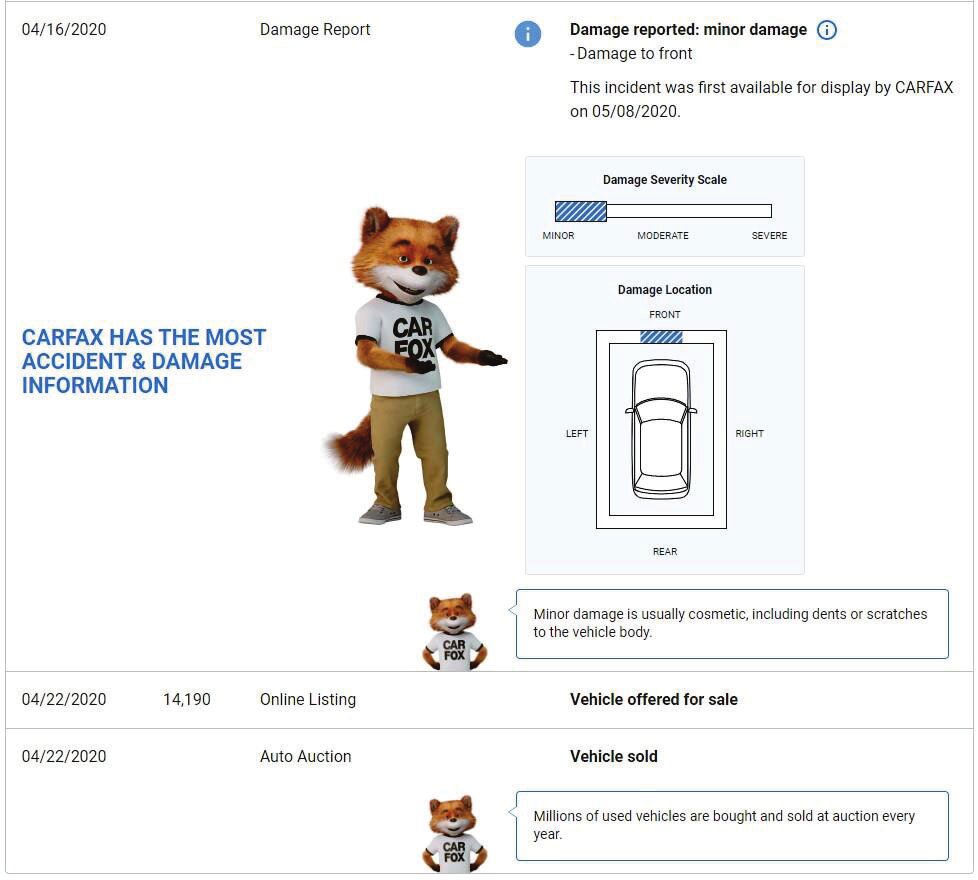
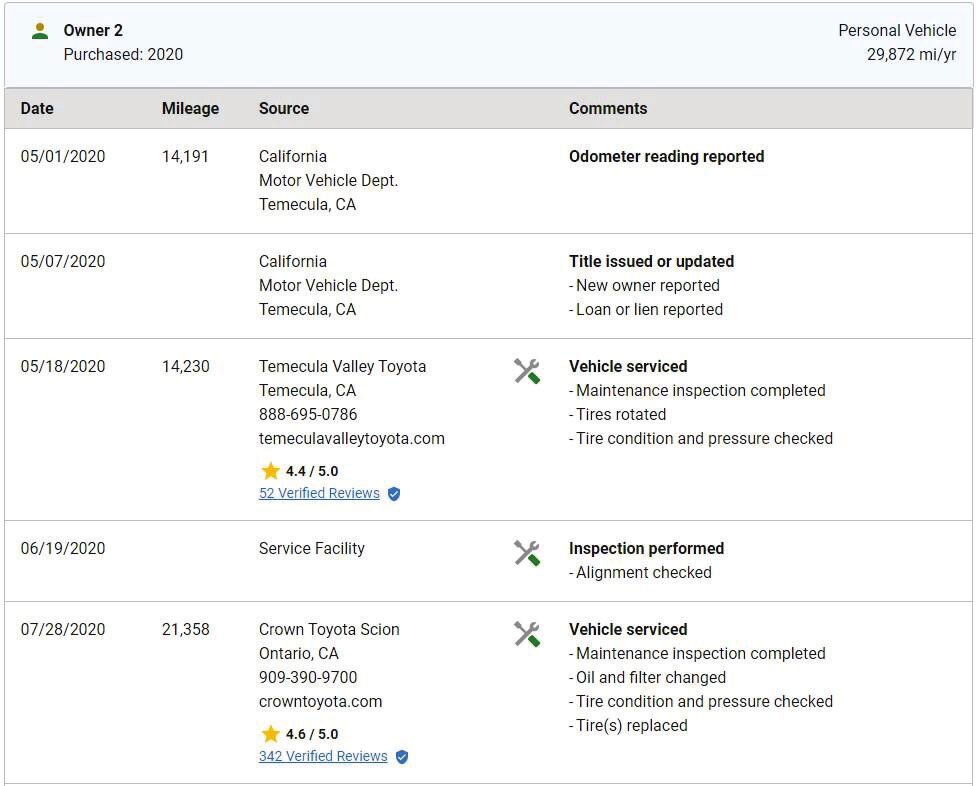
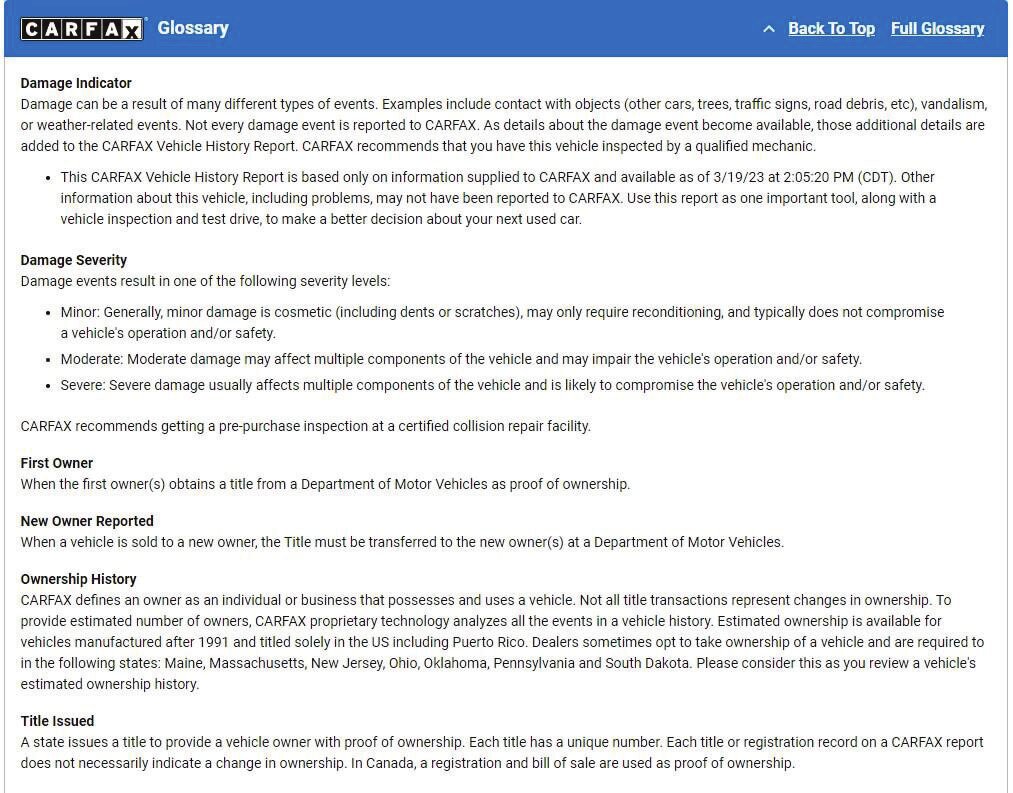
The Carfax report includes a variety of information about the vehicle’s history, including:
- Title information: The report can show whether the vehicle has a clean title, a salvage title, or has been reported as stolen.
- Odometer readings: The report can provide information on the vehicle’s odometer readings, which can help to identify potential fraud or odometer tampering.
- Accident history: The report can provide information on any reported accidents or damage to the vehicle.
- Service history: The report will show the vehicle’s service records, including repairs and maintenance performed over its lifetime.
- Ownership history: The report can show how many previous owners the vehicle has had, and in some cases, the report can provide information on the length of each ownership period.
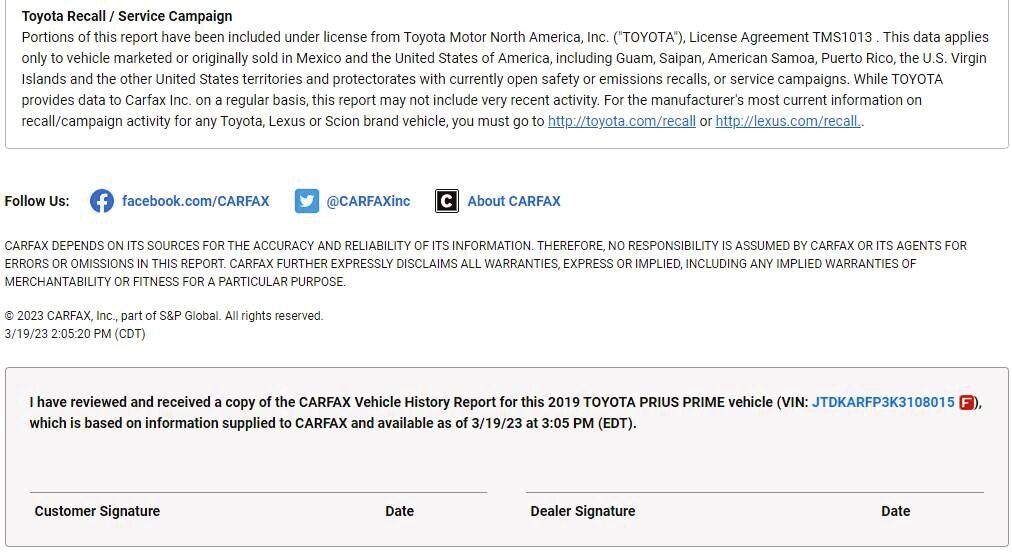
- Recall information: The report can show whether the vehicle has any open recalls that have not been addressed.
Consumers benefit from Carfax by being able to make more informed decisions about the vehicles they are considering purchasing. By reviewing the Carfax report, consumers can identify potential problems or issues with the vehicle’s history, which can help them to avoid purchasing a car with a hidden past.
Car dealers benefit from using Carfax by being able to provide more transparent information to their customers. By providing a Carfax report to a potential buyer, dealers can demonstrate that they are selling a vehicle with a clean history and no hidden problems. This can help to build trust with their customers and increase sales.
Carfax offers a range of pricing options, from a single report to a subscription service that provides access to multiple reports. The service is widely used by consumers who are considering purchasing a used car, as well as by car dealerships and other businesses that need to access vehicle history information on a regular basis.

AutoCheck
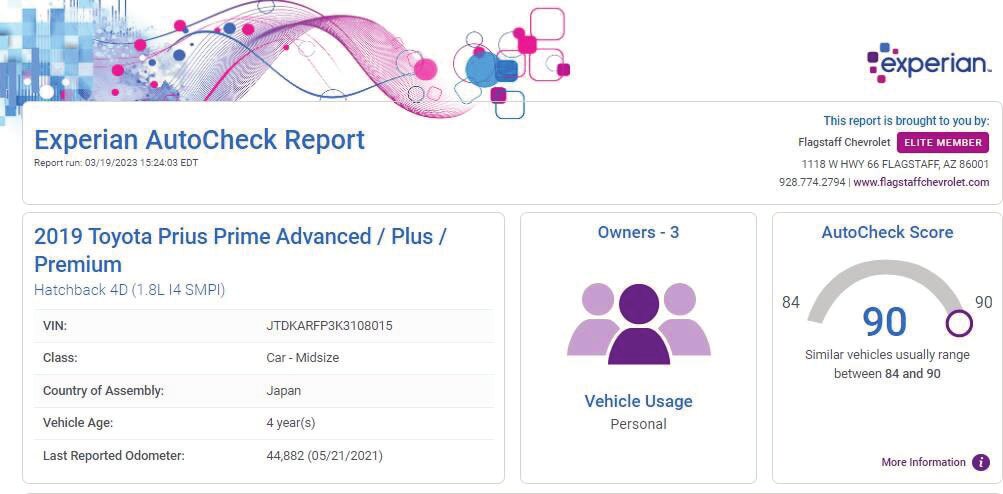
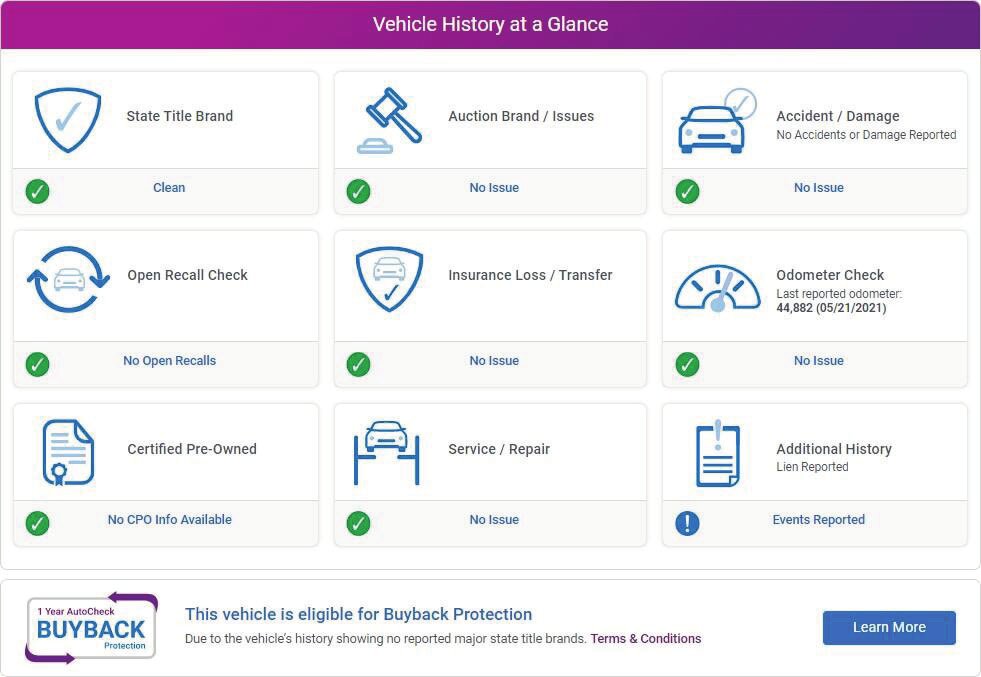
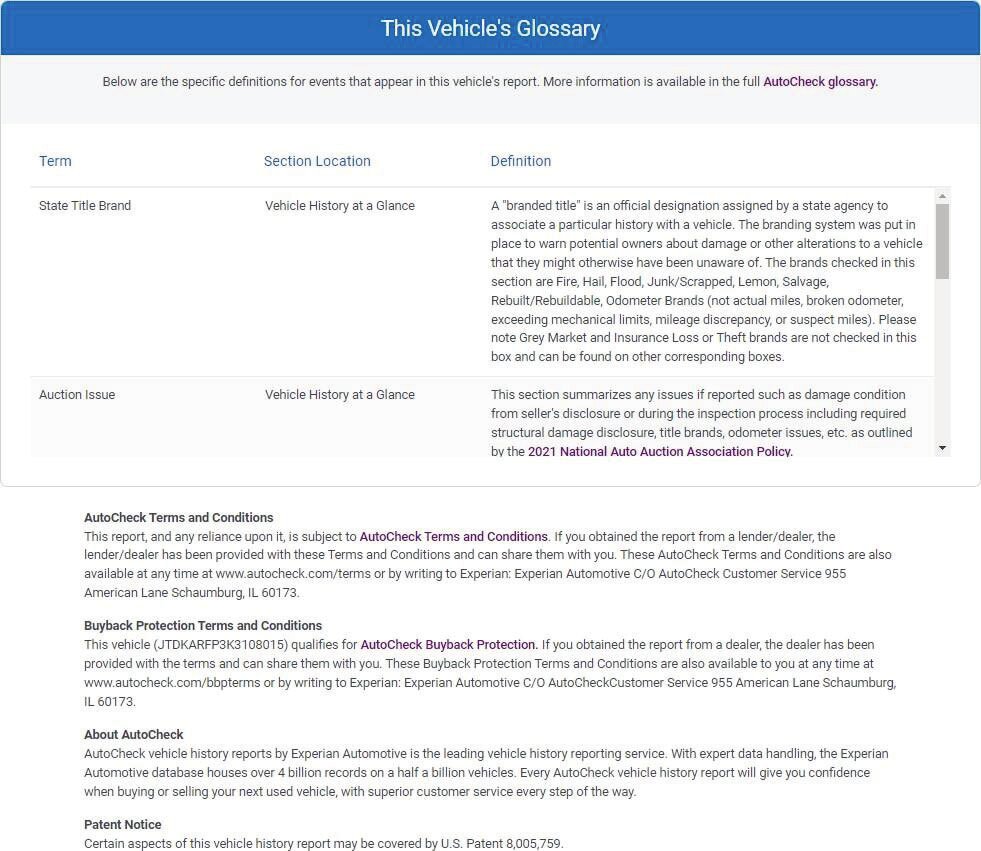
AutoCheck is a web-based service that provides vehicle history reports to consumers who are considering purchasing a used car. The service is owned and operated by Experian, a global information services company based in Dublin, Ireland. The report is commonly used as a window into auction condition reports along with providing extra guidance for consumers.
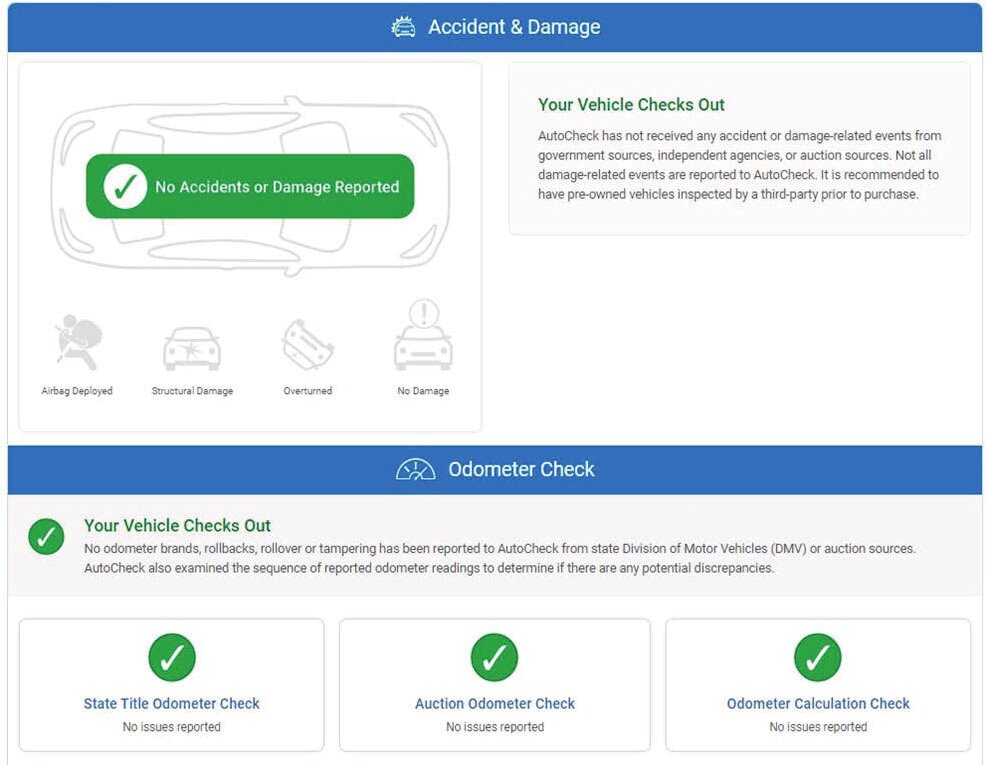
The AutoCheck report is important to review before a customer buys a car because it provides a comprehensive view of the vehicle’s history, including any accidents, repairs, or other issues that may impact its value or safety. By reviewing the AutoCheck report, consumers can make more informed decisions about the vehicles they are considering and avoid purchasing a car with a hidden past.
For dealers, the AutoCheck report can be a valuable tool for building trust with customers and increasing sales. By providing a vehicle history report from AutoCheck, dealers can demonstrate that they are selling a car with a clean history and no hidden problems. This can help to build confidence with their customers and increase the likelihood of a successful sale.
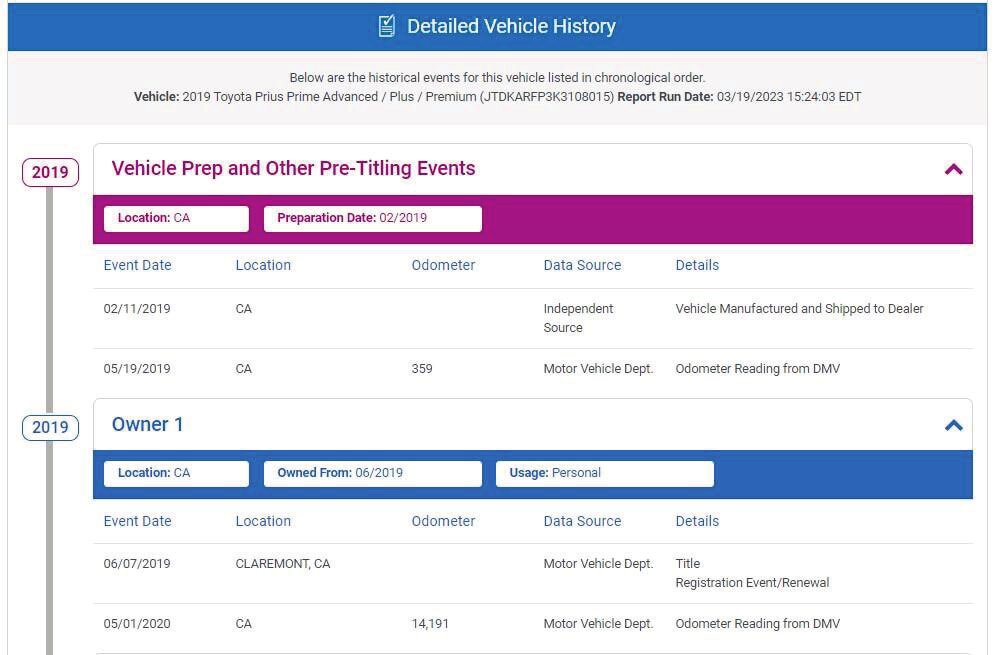
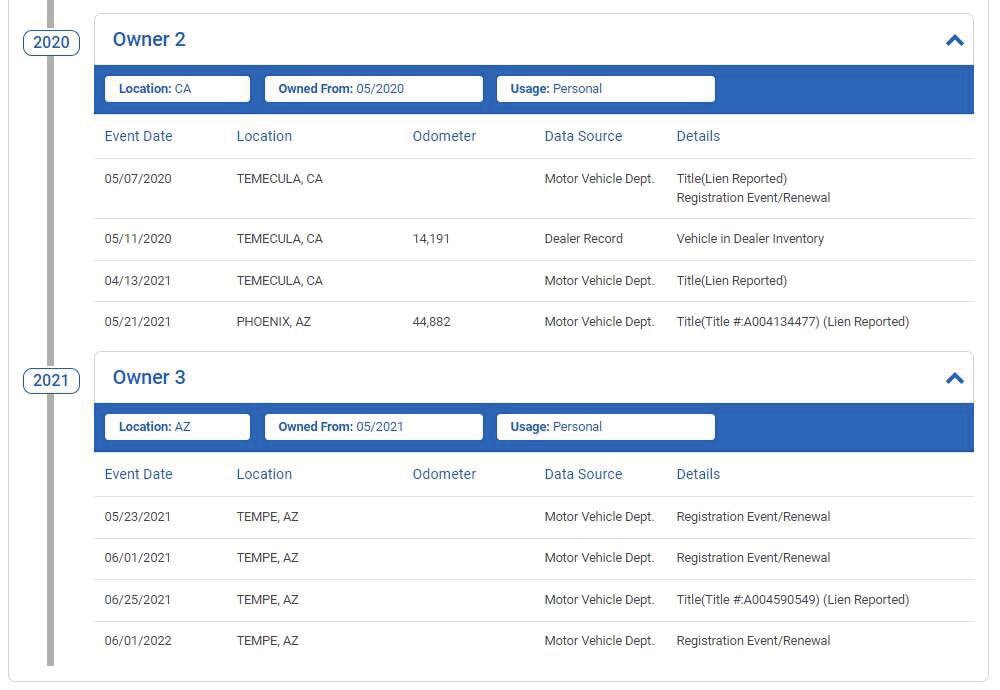
The AutoCheck report includes a variety of information about the vehicle’s history, including:
- Title information: The report can show whether the vehicle has a clean title, a salvage title, or has been reported as stolen.
- Accident history: The report can provide information on any reported accidents or damage to the vehicle.
- Odometer readings: The report can provide information on the vehicle’s odometer readings, which can help to identify potential fraud or odometer tampering.
- Service history: The report will show the vehicle’s service records, including repairs and maintenance performed over its lifetime.
- Ownership history: The report can show how many previous owners the vehicle has had, and in some cases, the report can provide information on the length of each ownership period.
- Recall information: The report can show whether the vehicle has any open recalls that have not been addressed.
AutoCheck offers a range of pricing options, from a single report to a subscription service that provides access to multiple reports. The service is widely used by consumers who are considering purchasing a used car, as well as by car dealerships and other businesses that need to access vehicle history information on a regular basis.

TrueFrame Report (Vehicle History Enhancement)
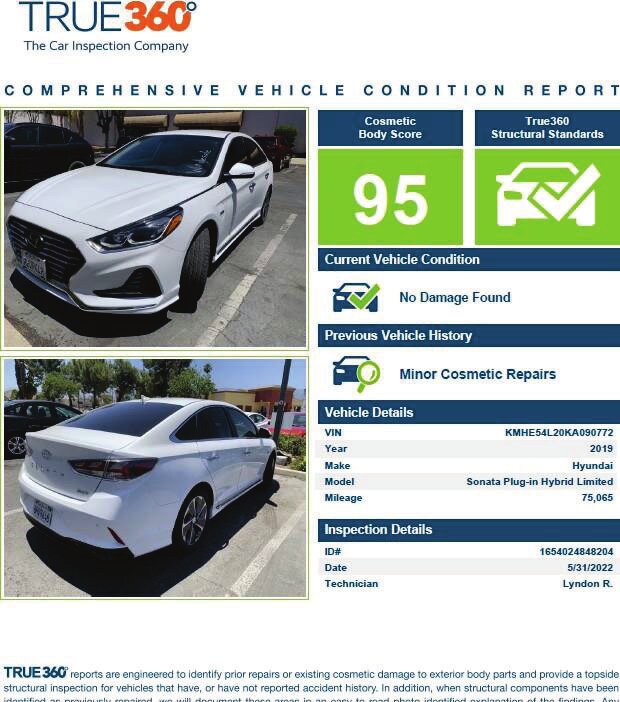
TrueFrame is a company that provides independent vehicle inspections and certifications to dealerships, individuals, and other businesses. The company was founded in 2019 by Jeffrey Risch and Tony Leopoldino.
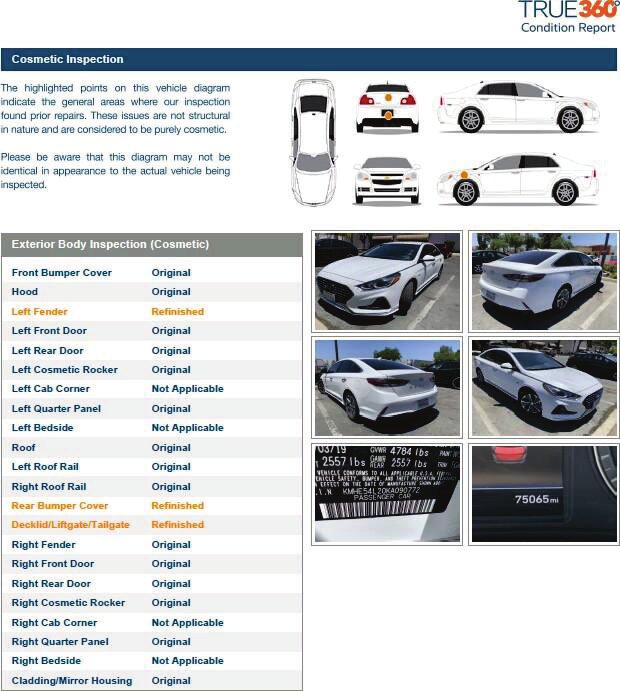
A TrueFrame report is a detailed inspection report that provides a comprehensive view of the vehicle’s condition and history. The report includes information on the vehicle’s structural integrity, previous damage, and repairs, as well as information on the vehicle’s history, including any accidents or other incidents that may have affected its value or safety.
The TrueFrame report is designed to help consumers make more informed decisions when purchasing a used car. By providing a detailed analysis of the vehicle’s condition and history, the report can help to identify any potential issues or concerns that may impact its value or safety. This can help consumers to avoid purchasing a car with hidden problems and ensure that they are getting a fair price for the vehicle.
In addition to providing valuable information for consumers, the TrueFrame report can also benefit dealerships and other businesses. By providing a certified inspection report, dealerships can demonstrate that they are selling a vehicle that has been thoroughly inspected and is in good condition. This can help to build trust with customers and increase the likelihood of a successful sale.
Overall, the TrueFrame report is a valuable tool for both consumers and dealerships. By providing a detailed analysis of the vehicle’s condition and history, the report can help to ensure that consumers make informed decisions when purchasing a used car, and that dealerships are selling vehicles that meet high standards of quality and safety.
TrueFrame, in addition to the other vehicle history reports, can give true full 360 transparency towards all the issues that have been reported regarding problems with potential vehicles. Keep in mind that these reports are only as good as the data that is being fed to them. It’s always in the dealer’s best interest to consider these as tools for guidance and trust, but always verify.
Buyers Guide – Second Page
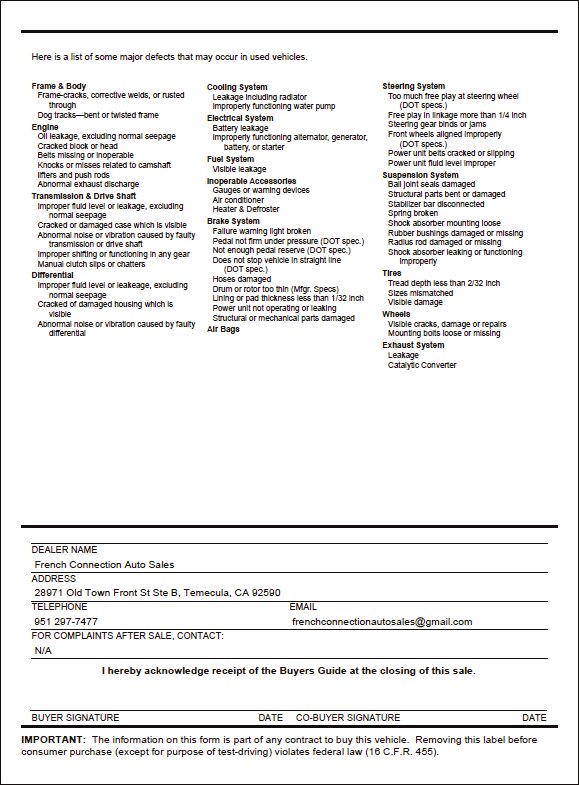
The second page of the buyer’s guide goes over all the major defects on a used vehicle. When a dealer puts all their contact information on the back and both the customer, and the dealer sign it. It is a good idea and recommended to have a buyer sign the first page as well.
Assembly Bill 68 – Used Car Sales Law
AB 68, also known as the Used Car Sales Law, is a California state law that was passed in 1985. The law is designed to protect consumers who purchase used vehicles by requiring dealers to disclose certain information about the vehicle’s condition, history, and warranty coverage.
Under the law, car dealers in California are required to provide buyers with a written disclosure document that includes information such as:
- Whether the vehicle has been in any accidents or has been damaged
- Whether the vehicle has been used as a rental or a fleet vehicle
- Whether the vehicle has been salvaged, rebuilt, or had its odometer rolled back
- Whether the vehicle comes with a warranty, and if so, the terms of that warranty
AB 68 also set the warranty rules for used vehicle sales, including the requirement to provide a warranty on certain vehicles depending on their age and mileage. Separately, the paid contract cancellation option that is sometimes still taught alongside AB 68 no longer exists. It was repealed on October 1, 2026 and replaced by the CARS Act’s 3-day right to cancel, covered later in this chapter.
The purpose of AB 68 is to give consumers more information and protection when purchasing a used vehicle, as well as to promote fair and honest practices in the used car industry.
To sell a vehicle under AB 68 laws, car dealers in California are required to fill out several forms, including a Vehicle History Report Disclosure form, a Used Vehicle Buyers Guide, and a Warranty Disclosure Statement. These forms are designed to provide buyers with the information they need to make an informed decision about the vehicle they are purchasing.
California Foreign Language Acknowledgement Form
The California Foreign Language Acknowledgment Form is a document that must be included with certain legal documents, such as real estate deeds or powers of attorney, when those documents are signed by individuals who do not speak English. The form is intended to ensure that non-English speakers understand the content of the document they are signing, even if they are not fluent in English.
The California Foreign Language Acknowledgment Form must be provided in the language that the signee understands. If the signee does not understand English, the form must be provided in their native language. If the signee understands English but is more comfortable reading or speaking another language, the form must be provided in that language. There is no specific list of languages that must be included with the form, as it will vary depending on the signee’s needs.
The inclusion of the California Foreign Language Acknowledgment Form is beneficial to customers because it ensures that they fully understand the content of the legal document they are signing. This can help to prevent misunderstandings, disputes, or legal issues down the line.
As for the Used Vehicle Buyers Guide, it is required by law that it be provided in both English and Spanish if the dealer conducts sales in Spanish. The Buyers Guide must be displayed on the vehicle, and the Spanish version must be a mirror translation of the English version. This is to ensure that Spanish-speaking buyers have access to the same information as English-speaking buyers and can make informed decisions about the used vehicle they are considering purchasing.
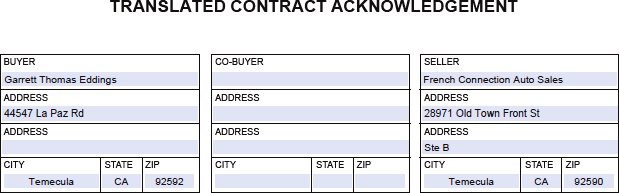
One of the first forms that should be completed out of the AB 68 forms is the California Foreign Language Acknowledgement Form.
The beginning portion of the form is relatively easy to navigate. You need to make sure that the buyer’s name and address are listed correctly along with the name of the dealership and their address.
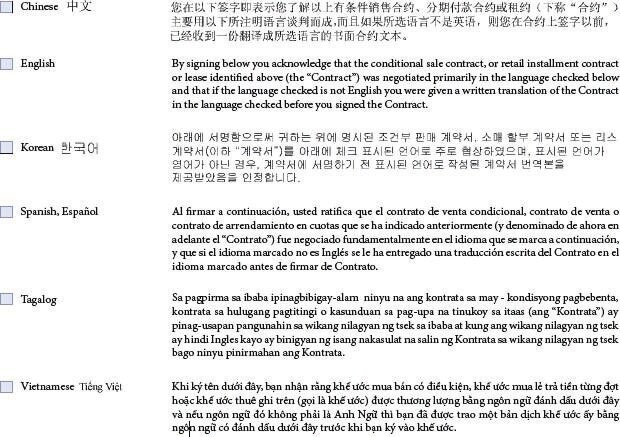
Next the customer needs to acknowledge which language they’d like to proceed with. Keep in mind, the dealership needs to provide buyers guides, purchase orders and contracts in:
- Chinese
- English
- Korean
- Spanish
- Tagalog
- Vietnamese
Here are some of the situations that arise when it comes to interpreters:
- If the dealership provides the interpreter, they must be a licensed salesperson for the dealership.
- The interpreter must be at least 18 years of age or older to be an interpreter.
- In the state of California, you must be at least 18 years of age or older to negotiate a contract. Important to keep in mind this also includes test driving a vehicle, which is a part of the negotiation process.
- It is a best practice to have a customer sign a REG 256, a statement of facts, indicating that they read and understand both English and the interpreted language.
- If the negotiations are done in Spanish, a Spanish translation of the Federal Buyers Guide must be on the vehicle in question before negotiations start.
Once the customer has selected which language that they would like to proceed with, both the customer and the dealer will sign and date.
This form outlines the buyer’s name and address, the co-buyer’s name and address and the dealership’s name and address. It establishes that, in the language the customer has designated, that the contract, buyers and purchase order has been provided to the customer in the language they have specified that they speak.
If the dealer does not speak the language that the customer is requesting, there are a few steps that must be taken to ensure the process is handled correctly:
- Provide the customer the form they are requesting, in the language they are requesting, with a line through it. This will act as a translation copy for the customer.
- The customer will then receive the English copy of the form. This will be the actual document that the customer will sign. The customer will reference the translation copy to read over the documentation.
- Have the customer sign a REG 256 (Statement of Facts) indicating that the customer has been provided all necessary documentation in both English and the interpreted language.

The 3-Day Right to Cancel (CARS Act)
California’s CARS Act (SB 766) took effect October 1, 2026. It replaced the old paid contract cancellation option with a 3-day right to cancel that comes with the purchase at no charge. If you learned the 2-day contract cancellation option, that product no longer exists. You cannot sell it, and you should pull the old forms out of the F&I office and out of your software’s product menu. Everything below reflects the law as it applies now.
Who the right covers
A used vehicle sold or leased at retail for $50,000 or less. Exactly $50,000 is included. The right does not apply to new vehicles, and it does not apply to motorcycles at any price, because motorcycles are excluded from the statute’s “used vehicle” definition entirely.
It is also excluded for wholesale sales, vehicles that are not required to be registered, fleet sales of more than one vehicle in a single transaction for business use, sales to a commercial purchaser who buys five or more vehicles a year for business use, vehicles with a GVWR of 10,000 pounds or more, qualifying used vehicles sold at auction, and the sale of a leased vehicle to a lessee who already had possession of it.
How the three days are counted
The clock starts the calendar day after the purchase or lease contract is executed. It ends at close of business on the third calendar day. If the third day falls on a day the dealership is closed to the public, the window runs to the next day the dealership is open.
Do not call this 72 hours or three business days. It is three calendar days. Example: a contract executed on a Saturday gives Sunday as day one, Monday as day two, and Tuesday as day three. If the dealership is closed on Tuesday, the window runs to the next open day.
The right is lost if the vehicle has been driven more than 400 miles between signing and the attempt to cancel. Exactly 400 miles is not over the limit.
What the dealer may charge
The base restocking fee is 1.5% of the vehicle sale price, with a $200 minimum and a $600 maximum. If the vehicle was driven more than 250 miles, the dealer may also charge $1 per mile over 250, capped at $150. The two can combine to $750 at most. These fees are permitted, not mandatory.
If the dealer charged a shipping fee, the dealer may retain the actual shipping cost instead of the base fee, up to the same cap, and must refund the difference. Deduct the restocking fee from any refund that is available, and collect only an uncovered balance when the right is exercised.
Watch two different numbers. The 250-mile figure is the threshold for the mileage fee. The 400-mile figure is the eligibility cutoff for the right itself. They are not the same thing.
What the customer must return
The buyer or lessee must personally deliver the vehicle during business hours, free of any liens other than those created by or incidental to the transaction, in the same condition it was delivered, apart from reasonable wear and tear and any defect or mechanical problem that appears after delivery and was not caused by the buyer. The customer also returns any cash or items received from the dealer.
If the dealer claims damage beyond reasonable wear and tear, the dealer has to document it. A new symptom on its own does not establish that the customer caused the damage.
The refund and the trade-in
The dealer must cancel the contract and issue a full refund, less any permitted deduction, within 48 hours of the customer exercising the right. Delays outside the dealer’s control, including financial-institution processing, are excepted. If payment has not verified immediately, such as a check, the refund may wait until two business days after verification, and the dealer should document when verification happened.
Return the trade-in and all keys unless it has already been sold or the title-transfer process has started. In that case the trade-in refund is the greatest of the trade-in value agreed in the contract, the actual sale price, or fair market value. Fair market value carries a rebuttable presumption when it comes from a prior written offer valid at least 7 days, or from a nationally recognized pricing guide reflecting the vehicle’s condition at trade-in. If the dealer sold the trade-in, provide the sale document with the next buyer’s personal information redacted.
The cancellation receipt must identify the date and time the right was exercised and itemize the deductions.
Acts that are themselves violations
During a cancellation it is a violation to impede the customer from exercising the right; overcharge the restocking fee; withhold the down payment or trade-in after the right is exercised; fail to refund the down payment in time; fail to refund a trade-in that was sold; fail to provide the receipt or the sale contract for the trade-in; claim damage beyond reasonable wear and tear without a reasonable basis; or claim that the person authorized to return the money or vehicle is unavailable.
The Act does not require a separate signed acknowledgment as a condition of cancelling. Ask only for documents reasonably necessary to effect the cancellation and refund or to comply with law, and do not turn a vendor’s acknowledgment package or a toll declaration into an extra gate the customer has to pass.
The three required disclosures
There are three separate documents, and none substitutes for another.
- The posted notice (Vehicle Code §11709.2). At least 36-point type, posted in every sales office, every sales cubicle, and every room where sale or lease contracts are regularly executed. It reads: “CALIFORNIA DOES NOT HAVE A COOLING-OFF PERIOD FOR NEW VEHICLES. BUT IF YOU PURCHASED OR LEASED A USED VEHICLE FOR $50,000 OR LESS, YOU HAVE 3 DAYS TO CANCEL THIS CONTRACT FOR ANY REASON. ADDITIONAL RESTRICTIONS MAY APPLY, INCLUDING A RESTOCKING FEE. ASK THE DEALER FOR MORE INFORMATION ABOUT HOW TO EXERCISE THIS RIGHT.” If the dealership also sells or leases motorcycles or off-highway vehicles at the same location, the notice must add, in the same 36-point type: “This cooling-off period also does not apply to the sale of a motorcycle or an off-highway motor vehicle subject to registration under California law. See the vehicle contract for details.”
- The separate cancellation disclosure (Civil Code §1784.43(b)). A document titled “3-Day Right to Cancel Used Car Purchase or Lease,” separate from the contract. It names the dealer and the buyer, describes the vehicle and its VIN, states the deadline for exercising the right and how to do it, states that the right itself is free but a restocking fee may apply with both components explained, states the 400-mile restriction, lists what the customer must deliver in person, covers the trade-in rules, and describes the proof of sale if the dealer says the trade-in was sold.
- The first page of the contract (Civil Code §1784.43(e)). The purchase or lease agreement itself must carry a notice on page one: “CALIFORNIA DOES NOT HAVE A COOLING-OFF PERIOD FOR NEW VEHICLES. HOWEVER, IF YOU PURCHASED OR LEASED A USED VEHICLE FOR $50,000 OR LESS, YOU HAVE 3 DAYS TO CANCEL THIS CONTRACT FOR ANY REASON. ADDITIONAL RESTRICTIONS MAY APPLY, INCLUDING A RESTOCKING FEE. You have up to 3 days to return the vehicle to the dealer and cancel this contract and obtain a refund. Please review the disclosure, which the dealer is required by law to provide, for the details about this right and how to exercise it.”
The posted notice says “BUT,” while the contract notice says “HOWEVER” and carries two extra sentences. That is not a typo. They are two different required texts.
The contract forms changed with the Act. The conditional sale contract and the lease agreement now carry this first-page notice in place of the old “THERE IS NO COOLING-OFF PERIOD UNLESS YOU OBTAIN A CONTRACT CANCELLATION OPTION” language, and the contract itemization no longer has a line for a contract cancellation option charge.
If the transaction is negotiated primarily in Chinese, Korean, Spanish, Tagalog, or Vietnamese, the add-on disclosures and the separate cancellation disclosure have to be provided in that language as well.
Worked examples
A $20,000 vehicle returned on day two with 300 miles on it. The base restocking fee is $300 (1.5% of $20,000). The mileage fee is $50 (50 miles over 250 at $1 per mile). The permitted total is $350.
A vehicle driven exactly 400 miles is still within the right, because only more than 400 miles removes it.
A mechanical problem that appears after delivery and was not caused by the buyer does not defeat the return. A new symptom alone is not proof that the customer caused damage.
A trade-in the dealer already sold is refunded at the greater of the contract value, the actual sale price, or fair market value, and the customer is entitled to the redacted sale document.
An otherwise eligible return at the top of both fee scales reaches $750, which is the $600 base maximum plus the $150 mileage maximum.
Pre-Contract Disclosure/Optional Products and Services Disclosure
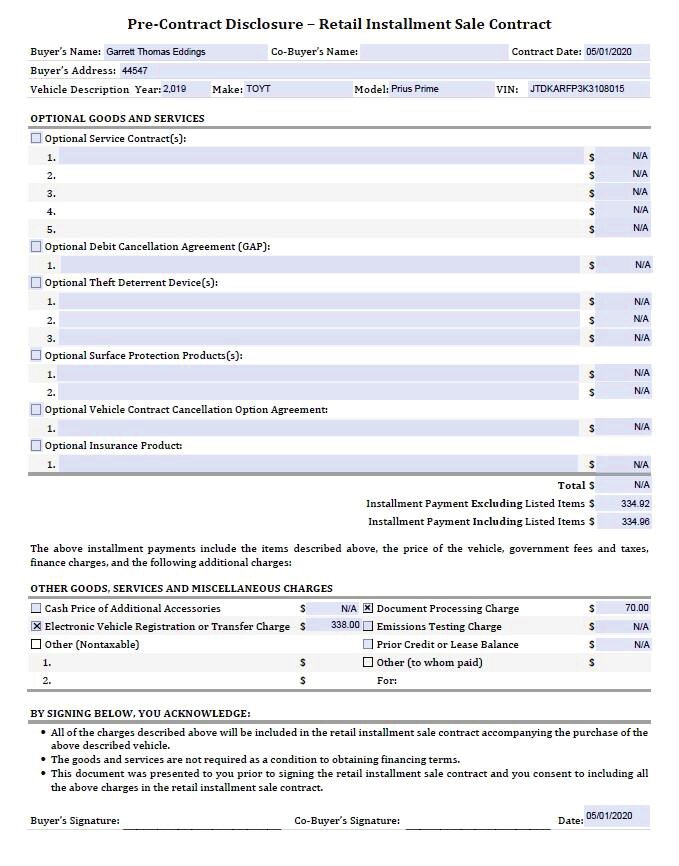
An Optional Products and Service Disclosure form is a document that California car dealers are required to provide to customers to disclose any optional products or services that are being offered for sale in connection with the purchase or lease of a vehicle. This form is required under California law to ensure that consumers have a clear understanding of the cost and value of any additional products or services that they may be purchasing.
The disclosure form is beneficial to consumers because it allows them to make informed decisions about their purchase and avoid any unexpected or unnecessary costs. The form lists the optional products and services that are available for purchase, along with the cost of each item and a brief description of what it covers.
The following items are required to be listed on the Optional Products and Service Disclosure:
- GAP Waiver or similar debt cancellation agreement
- Service contract or extended warranty
- Prepaid maintenance plan
- Appearance protection product
- Theft deterrent product
- Vehicle protection product
- Key replacement product
- Etching product
- Tire and wheel protection product
If a customer does not receive an Optional Products and Service Disclosure form from the dealer, they may be able to cancel any optional products or services that they were charged for. The customer may also be able to take legal action against the dealer for failing to provide the required disclosure.
Let’s look more in depth to each of these items:
CARS Act rules for add-ons
California’s CARS Act (SB 766) adds two duties around optional products, and both are easy to miss.
Written optionality disclosure. Any time the dealer makes a written representation about an add-on during negotiation, the dealer has to disclose at least once, in writing and clear and conspicuous, that the add-on is not required and the vehicle can be purchased or leased without it. In a deal negotiated primarily in Chinese, Korean, Spanish, Tagalog, or Vietnamese, that disclosure comes in that language too.
Do not charge for an add-on the customer would not benefit from. The statute names seven examples: nitrogen tire products under 95% purity; products or services that provide no coverage for the vehicle, the consumer, or the transaction; a GAP agreement that does not comply with Civil Code §2982, §2982.2, or §2982.12; a service contract that is void because of preexisting conditions, including prior crash or flood damage or a preexisting mechanical condition; oil changes for an electric vehicle; a catalytic converter marking on a vehicle that does not have a catalytic converter; and a surface protection product that voids the manufacturer’s paint warranty.
Unused is not the same as no benefit. A customer not using a product does not by itself mean no benefit was conferred. The test is whether the benefit could apply, not whether the customer used it.
Pay the provider within 10 days. The dealer has to pay whoever provides the add-on benefit within 10 days of signing, unless there is an agreement for later payment and coverage is not affected by the delay. Keep proof of the payment; it is one of the records the Act requires you to retain.
GAP Insurance
GAP insurance is an optional type of auto insurance that covers the difference, or “gap,” between the amount that a driver owes on their car loan or lease and the actual cash value of the vehicle if it is totaled or stolen. GAP is short for Guaranteed Asset Protection, and it can be a great item for customers to purchase at your dealership. Let’s look at both sides.
The pros of GAP insurance are:
- Protects against financial loss: If a car is totaled or stolen, the insurance payout may not cover the full amount owed on the loan or lease. GAP insurance protects against this financial loss.
- Affordable: GAP insurance is often relatively inexpensive compared to other types of auto insurance.
- Provides peace of mind: Knowing that you have gap insurance can give you peace of mind, especially if you have a large car loan or lease.
The cons of GAP insurance are:
- Limited coverage: GAP insurance only covers the difference between the loan or lease amount and the actual cash value of the vehicle. It does not cover other expenses, such as repairs or medical bills.
- Not always necessary: GAP insurance may not be necessary if you have a small loan or lease, or if you have a large down payment on the vehicle.
GAP insurance is beneficial for car dealers to offer to their clients because it can help protect the dealership’s financial interests. If a customer’s vehicle is totaled or stolen and they owe more on their loan or lease than the car is worth, the dealership may not be able to recoup the full amount owed. By offering GAP insurance, dealerships can help ensure that they receive the full amount owed, which can reduce their financial risk and help them stay in business. Additionally, offering GAP insurance can be a selling point for customers who are looking for added protection and peace of mind.
Service Contracts
We talked about service contracts earlier in class, however, let’s do another brief overview.
A service contract, also known as an extended warranty, is an optional contract offered by car dealerships that provides additional coverage for certain repairs and services beyond the manufacturer’s warranty. Service contracts typically cover major vehicle components, such as the engine, transmission, and electrical systems, and may include additional benefits like roadside assistance and rental car reimbursement.
Customers who buy used cars should consider service contracts because they provide added protection and peace of mind against unexpected repair costs. Used cars are more likely to require repairs than new cars, and the cost of these repairs can add up quickly. A service contract can help mitigate these costs and provide customers with assurance that their vehicle is covered if something goes wrong.
For dealerships, selling service contracts is beneficial because it can help increase revenue and customer satisfaction. Service contracts are typically sold at a markup, meaning that dealerships can earn additional profit on each sale. Additionally, offering service contracts can help build trust and loyalty with customers by providing them with added value and protection. This can lead to repeat business and positive word-of-mouth referrals.
It’s important for customers to carefully review the terms and conditions of a service contract before purchasing, as not all service contracts are created equal. Some contracts may have restrictions or exclusions that limit the coverage or only cover certain types of repairs. Customers should also be aware of the length of coverage, the deductible amount, and any other fees or costs associated with the contract.
Pre-Paid Maintenance Plan
A prepaid maintenance plan is an optional service offered by car dealerships that provides customers with scheduled maintenance services at a discounted rate. Typically, customers pay upfront for a set number of maintenance visits or a specified time period, such as three years or 30,000 miles. Maintenance services may include oil changes, tire rotations, brake inspections, and other routine services.
There are several benefits for customers to purchase a prepaid maintenance plan when they buy a used car from a dealer:
- Convenience: Prepaid maintenance plans provide customers with a convenient way to keep their car in good condition, without having to worry about scheduling and paying for individual services as they come up.
- Cost savings: Prepaid maintenance plans typically offer a discounted rate compared to paying for each service individually, which can save customers money over time.
- Peace of mind: By purchasing a prepaid maintenance plan, customers can have peace of mind knowing that their car is receiving regular maintenance and that any potential issues will be caught early.
- Increased resale value: A car with a documented history of regular maintenance may have a higher resale value than one that does not, making a prepaid maintenance plan a good investment for customers who plan to resell their car in the future.
Overall, a prepaid maintenance plan can be a smart investment for customers who want to keep their used car in good condition and save money on routine maintenance services. It can also provide peace of mind and potentially increase the resale value of the vehicle. If a dealership offers repairs of any kind, even going so far as to refer a customer for work at another shop, the dealership must have a BAR License.
BAR License
In California, if a dealership performs repairs, they must have a valid Automotive Repair Dealer license issued by the Bureau of Automotive Repair (BAR). This license is required for businesses that perform any type of repair work on vehicles, including mechanical, electrical, or body repairs.
To obtain a BAR license in California, there are several requirements that must be met. These include:
- Completing a BAR-approved training program: All individuals who perform repairs for the dealership must complete a BAR-approved training program in automotive repair.
- Passing a written examination: All individuals who perform repairs for the dealership must pass a written examination administered by the BAR.
- Meeting business requirements: The dealership must meet all business requirements set forth by the BAR, including having a valid business license, insurance, and a properly equipped repair facility.
- Paying applicable fees: The dealership must pay all applicable fees associated with obtaining and maintaining a BAR license.
A BAR license is beneficial for a dealership in California because it demonstrates to customers that the dealership is licensed, trained, and qualified to perform repairs on their vehicles. It also provides customers with the assurance that their vehicle is being repaired by professionals who are accountable to the state regulatory agency. Additionally, having a BAR license can help a dealership stand out from its competitors and attract more customers who value quality repairs and professional service.
Vehicle Appearance/ Protection Plan
A vehicle appearance/protection plan is an optional service that dealerships may offer to customers to protect the appearance of their vehicle. This can include various services such as paint and fabric protection, rustproofing, windshield protection, and more. These plans typically come at an additional cost and can be added to a customer’s purchase price or financed into their auto loan.
The benefits of a vehicle appearance/protection plan for a customer include:
- Maintaining the appearance of the vehicle: By protecting the exterior and interior of the vehicle, customers can help to preserve its appearance and protect its resale value.
- Ease of maintenance: By protecting the vehicle’s surfaces, it can make cleaning and maintenance easier, saving the customer time and effort.
- Protection from environmental factors: Services such as rustproofing and paint protection can help to protect the vehicle from environmental factors such as salt, moisture, and UV rays, which can cause damage over time.
- Potential cost savings: By preventing damage from occurring, a vehicle appearance/protection plan can potentially save the customer money on costly repairs or replacements.
Overall, a vehicle appearance/protection plan can be a good investment for customers who want to protect their investment and keep their vehicle looking its best. It can potentially save the customer money on repairs and maintenance while also helping to preserve the resale value of the vehicle.
Vehicle Etching/ Key, Wheel, Tire Replacement
Vehicle etching is a process where a unique identification number is etched onto the windows of a vehicle, making it more difficult for thieves to steal and sell the vehicle. This process can deter thieves and may help to recover the vehicle if it is stolen.
Key, wheel, and tire replacement plans are optional services that dealerships may offer to customers to protect their investment in the vehicle. Key replacement plans offer coverage for lost or damaged keys, while wheel and tire replacement plans offer coverage for damage to wheels and tires caused by road hazards.
The benefits of purchasing these optional items when buying a used car from a dealership include:
- Theft prevention: Vehicle etching can deter thieves and may make the vehicle less attractive to steal.
- Peace of mind: Key, wheel, and tire replacement plans can offer customers peace of mind knowing that they are protected from unexpected and costly repairs.
- Cost savings: By purchasing these optional plans, customers can potentially save money on repair and replacement costs over the life of the vehicle.
- Convenience: Key, wheel, and tire replacement plans can offer customers convenient solutions for unexpected issues that may arise with their vehicle.
Overall, while these optional plans come at an additional cost, they can provide customers with added protection and peace of mind knowing that their investment is safeguarded. It is important for customers to carefully consider these options and weigh the costs and benefits before making a decision.
Optional Products and Services Disclosure forms provide transparency to a used car deal that allow the customer to know exactly what they are paying for an itemized list of those products and lets the customer know what it would cost with or without the products being offered.
Some of the benefits to dealerships that offer services like this, beyond an increase in revenue, can be offsetting some of the costs that come with financing a customer that has subprime credit. Customers with subprime credit will often lead to discount fees that are extended to a dealership on behalf of the financial institution that they use during the financing process. In the next section, we’ll talk about financing and what forms are involved with that.
In addition to the optional goods and services, the form also outlines other miscellaneous charges that are included with the deal that aren’t options. Things like:
- Cash Price of Additional Accessories
- Electronic Vehicle Registration or Transfer Charge
- Document Processing Charge (Doc Fees)
- Emissions Testing Charge
- Prior Credit or Lease Balance
This form must be signed and dated by the customer and the customer must receive a copy.
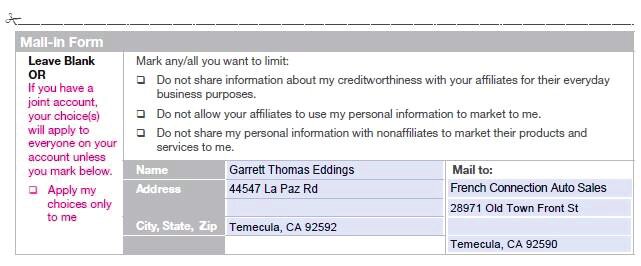
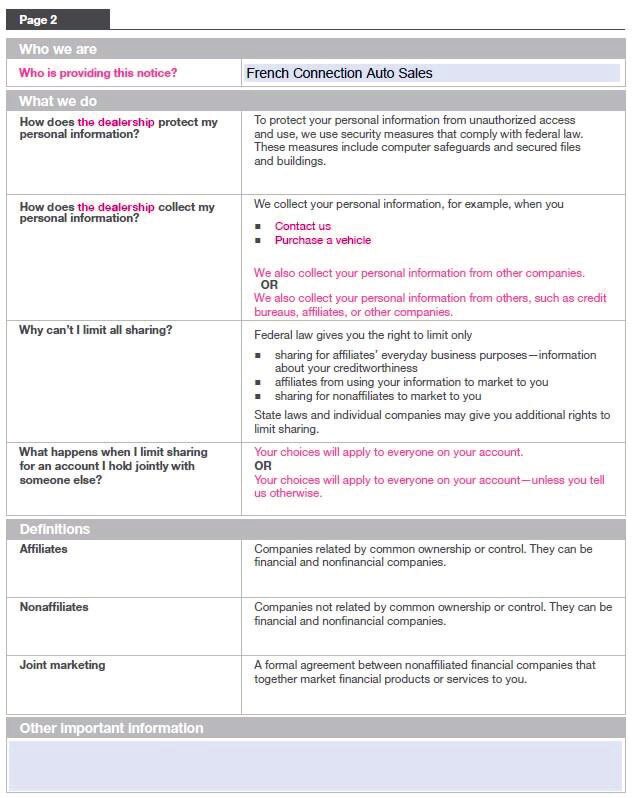
Privacy Policy
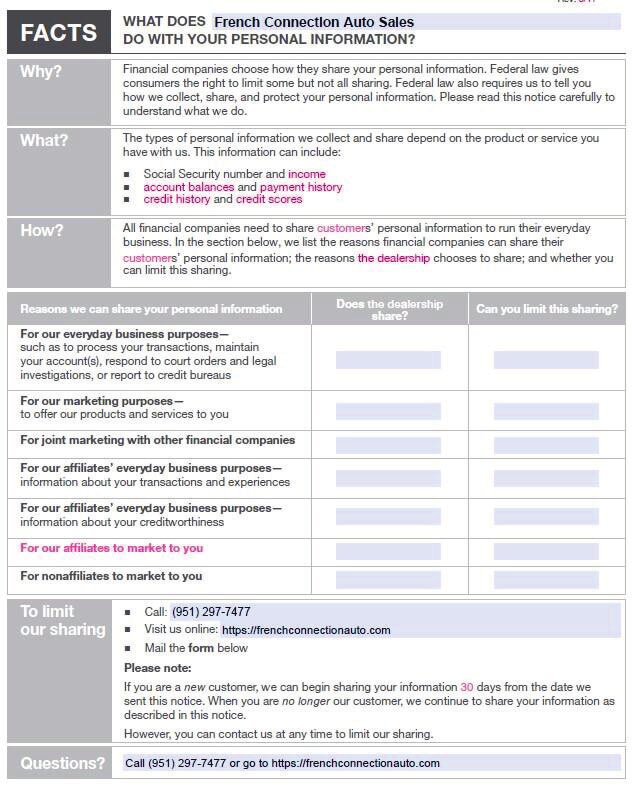
The Gramm-Leach-Bliley Act (GLBA), also known as the Financial Services Modernization Act, is a federal law that regulates the collection, use, and disclosure of personal financial information by financial institutions, including car dealerships that provide financing and insurance products to their customers.
The Safeguards Rule is a part of the GLBA that requires financial institutions to develop, implement, and maintain a comprehensive information security program to protect customer information. The Safeguards Rule requires financial institutions to assess risks to customer information, design and implement a safeguard program to mitigate those risks, and regularly monitor and test the effectiveness of those safeguards.
Car dealerships in California are subject to the GLBA and the Safeguards Rule if they provide financing or insurance products to their customers. This means that dealerships must have a comprehensive information security program in place to protect customer information, including physical, administrative, and technical safeguards to prevent unauthorized access to customer information.
Under the Safeguards Rule, car dealerships must:
- Designate one or more employees to coordinate the information security program.
- Conduct a risk assessment to identify potential risks to customer information.
- Develop and implement a written information security program that includes administrative, technical, and physical safeguards to protect customer information.
- Regularly monitor and test the effectiveness of the safeguards and make necessary changes to the program.
Overall, car dealerships in California must comply with the GLBA and the Safeguards Rule to protect their customers’ personal and financial information. This includes developing and maintaining a comprehensive information security program that addresses potential risks and safeguards customer information.
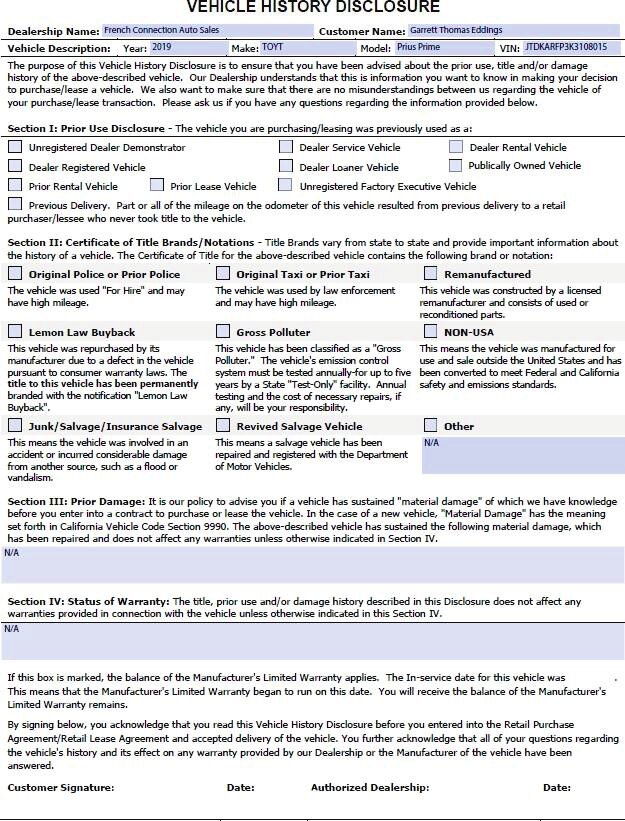
Used Vehicle History Disclosure Form
The Used Vehicle History Disclosure form is a document required for used car sales by dealerships in California. The form is designed to provide customers with information about the vehicle’s history, such as whether it has been involved in any accidents, if it has any liens, if it has ever been salvaged or rebuilt, or if it has had any major repairs.
The Used Vehicle History Disclosure form is required by law to be provided to customers before they purchase a used vehicle from a dealership in California. The purpose of this requirement is to ensure that customers are fully informed about the condition and history of the vehicle they are purchasing, and to protect them from any misrepresentation or fraud by the dealership.
By providing customers with a comprehensive history of the used vehicle they are considering purchasing, the Used Vehicle History Disclosure form allows customers to make an informed decision about whether to proceed with the purchase or not. It also helps customers to identify potential problems with the vehicle that may affect its value or safety.
Part 2 Video: Forms Required for Finance Deals and Consignment
Part 2 Reading: Forms Required for Finance Deals and Consignment
Disclosures of Consumer Credit and Notice to Vehicle Credit Applicant
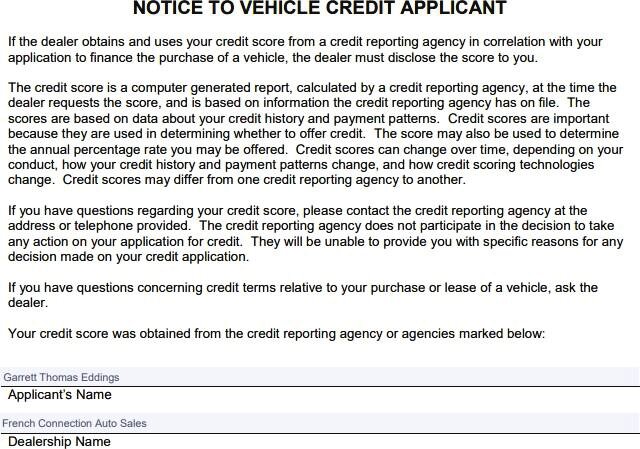
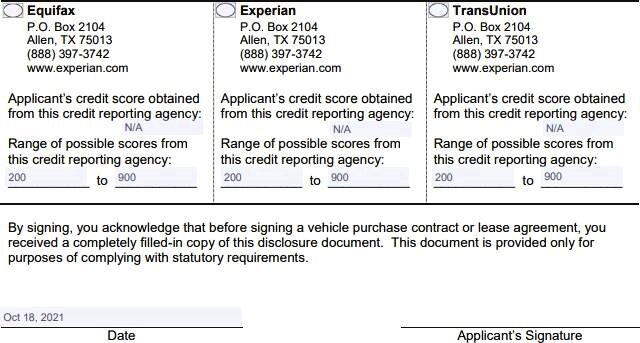
When offering credit or financing at a dealership, it is important to remember that a dealership cannot give a customer a copy of their credit report. Instead, you give the customer a notice to the applicant going over their credit report. Here are some of the items that must be included in this report.
- The name of the consumer
- The name of the dealership
- The customer’s credit score
- How is that score utilized at the dealership?
- How do you receive a copy of that credit report?
- How can you get in contact with the credit bureau if you have questions or need to address problems with the information in the report.
Red Flags Rule
The Federal Trade Commission’s Identity Red Flags Rule is a set of regulations designed to protect consumers and businesses from identity theft. The rule requires financial institutions and creditors, including car dealerships, to develop and implement an identity theft prevention program that is tailored to their particular business and risks.
The Identity Red Flags Rule is important because identity theft can have serious financial and personal consequences for individuals and businesses. By implementing an effective identity theft prevention program, car dealerships can help to safeguard their customers’ personal and financial information, reduce the risk of fraud and identity theft, and comply with federal regulations.
The Identity Red Flags Rule program requires car dealerships to identify, detect, and respond to warning signs, or “red flags,” that may indicate the possibility of identity theft. Some examples of red flags in the automotive industry may include:
- Suspicious identification documents, such as a driver’s license that appears to be altered or fake.
- An unusual or suspicious pattern of vehicle purchases or financing.
- Requests to use a different address or phone number than those on file.
- Alerts or notifications from credit reporting agencies or other sources indicating possible fraud or identity theft.
To comply with the Identity Red Flags Rule, car dealerships must create a written identity theft prevention program that includes:
- A program administrator who is responsible for overseeing the program.
- A risk assessment to identify potential red flags and assess the dealership’s level of risk.
- Policies and procedures for detecting, preventing, and responding to red flags.
- Training for employees on how to identify and respond to red flags.
- Oversight of third-party service providers who may have access to customer information.
Overall, the Identity Red Flags Rule is an important program for car dealerships in California and across the country. By implementing effective identity theft prevention programs, car dealerships can help to protect their customers’ personal and financial information, reduce the risk of fraud and identity theft, and comply with federal regulations.
Truth In Lending Act & Key Elements Car Dealers Need to Be Aware Of
- The Truth in Lending Act (TILA) is a federal law that requires lenders to disclose the terms and conditions of a loan or credit transaction, including the annual percentage rate (APR) and other associated costs, to consumers. This law applies to all forms of consumer credit, including conditional sales contracts for used vehicles purchased from California car dealers.
- A conditional sales contract is a type of financing agreement where the buyer takes possession of the vehicle but pays for it over time, typically with interest. Under TILA, car dealers must provide buyers with a clear and accurate disclosure of the financing terms and the total cost of the vehicle, including any fees or charges associated with the loan.
- Closed-end credit refers to a loan with a fixed term and a set number of payments, such as a car loan. Open-end credit, on the other hand, refers to a line of credit that can be used repeatedly up to a certain limit, such as a credit card.
- Prime credit refers to borrowers with a high credit score and a good credit history, while subprime credit refers to borrowers with a lower credit score or a history of delinquencies or defaults.
- The Equal Credit Opportunity Act (ECOA) is another federal law that prohibits lenders from discriminating against borrowers on the basis of race, color, religion, national origin, sex, marital status, age, or receipt of public assistance.
- Regulation Z is a set of regulations issued by the Federal Reserve Board under the Truth in Lending Act. It requires lenders to provide borrowers with clear and accurate disclosures of the terms and costs of credit transactions, including loans for the purchase of vehicles.
- The Federal Consumer Credit Protection Act is a federal law passed in 1968 that provides various protections to consumers regarding credit and debt. The law includes several titles, including the Truth in Lending Act, the Fair Credit Reporting Act, the Equal Credit Opportunity Act, and the Fair Debt Collection Practices Act, among others. These titles provide regulations and guidelines for creditors, credit bureaus, and debt collectors, and aim to ensure that consumers are treated fairly and provided with accurate information regarding credit and debt. The law is enforced by the Consumer Financial Protection Bureau and the Federal Trade Commission.
It is important to note that ALL these forms lead up to breaking down the conditional sales contract into more compartmentalized sections that make it easier for customers to understand.
Consignment
A consignment agreement for a used car dealer is a contract between the dealer and an individual (the “consignor”) who wants to sell their vehicle through the dealer. Under this agreement, the consignor entrusts the dealer to sell their vehicle on their behalf, with the dealer receiving a commission or fee for their services.
A typical consignment agreement for a used car dealer should include the following items:
- Description of the vehicle: This should include the year, make, model, and VIN number of the vehicle, as well as any other important details such as the mileage and condition of the vehicle.
- Selling price: The agreement should specify the minimum price that the consignor is willing to accept for the vehicle, as well as the commission or fee that the dealer will receive for selling the vehicle.
- Term of the agreement: The agreement should specify the length of time that the vehicle will be listed for sale with the dealer, as well as any renewal options or termination provisions.
- Responsibilities of the parties: The agreement should specify the responsibilities of the dealer and the consignor, such as who will be responsible for preparing the vehicle for sale, marketing the vehicle, and handling any paperwork related to the sale.
- Payment terms: The agreement should specify when and how the consignor will be paid for the sale of their vehicle, as well as any other fees or expenses that may be deducted from the sale proceeds.
In California, there is a 20-day timeline for a dealer to pay a consigner after the sale of their vehicle. The consignment agreement should specify the payment terms, such as when the consignor can expect to receive payment and how the payment will be made. It is important for dealers to honor the terms of the consignment agreement and make timely payments to consignors to maintain a good reputation and avoid legal disputes.
Part 3 Video: Conditional Sales Contract
Part 3 Reading: Conditional Sales Contract
Conditional Sales Contract
A conditional sales contract, in reference to used car sales at a dealership is a legal agreement between a buyer and a dealership, where the buyer agrees to purchase a vehicle on credit and makes payments over a period of time. This type of contract is commonly used in car financing, where the buyer does not pay the full purchase price upfront but rather makes payments over time.
The contract typically includes the terms of the sale, the vehicle information, the purchase price, the down payment amount, the interest rate, and the payment schedule. It may also include information about any warranties or service plans, as well as details about the buyer’s credit history and financing options.
A conditional sales contract is required to protect both the buyer and the dealership. The contract ensures that the buyer understands the terms of the sale and the financial obligations associated with purchasing the vehicle. It also protects the dealership by ensuring that the buyer is committed to making payments on time and that the dealership has legal recourse if the buyer defaults on the loan.
The detailed list of information on a conditional sales contract typically includes:
- Buyer and dealership information: Names, addresses, and contact information for both parties.
- Vehicle information: Make, model, year, mileage, VIN number, and any relevant features or options.
- Purchase price: The agreed-upon price for the vehicle.
- Down payment: The amount of money the buyer will pay upfront.
- Interest rate: The rate at which the loan will accrue interest.
- Payment schedule: The amount and frequency of payments.
- Total cost of credit: The total amount of interest and fees the buyer will pay over the life of the loan.
- Warranties and service plans: Details about any warranties or service plans that come with the vehicle.
- Credit information: Information about the buyer’s credit history and financing options.
- Default and repossession: Information about what happens if the buyer defaults on the loan or fails to make payments on time.
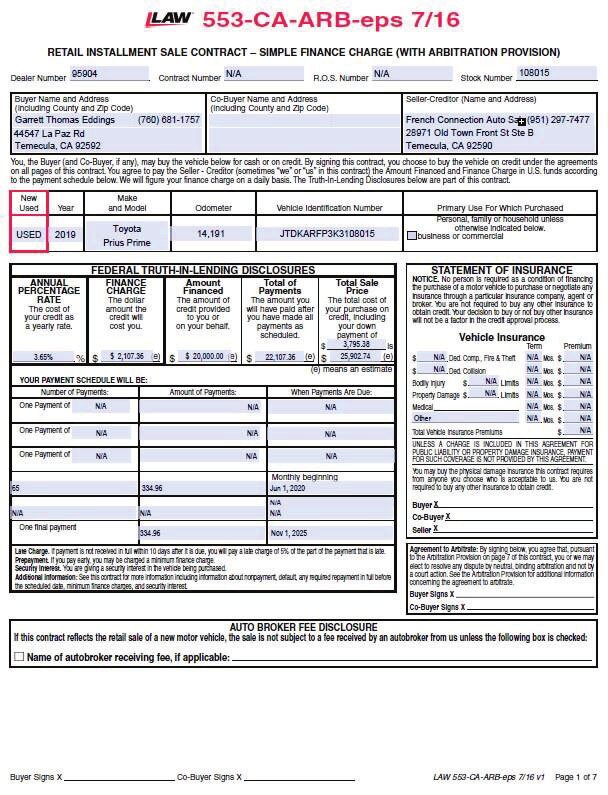
Page 1 of the Conditional Sales Contract
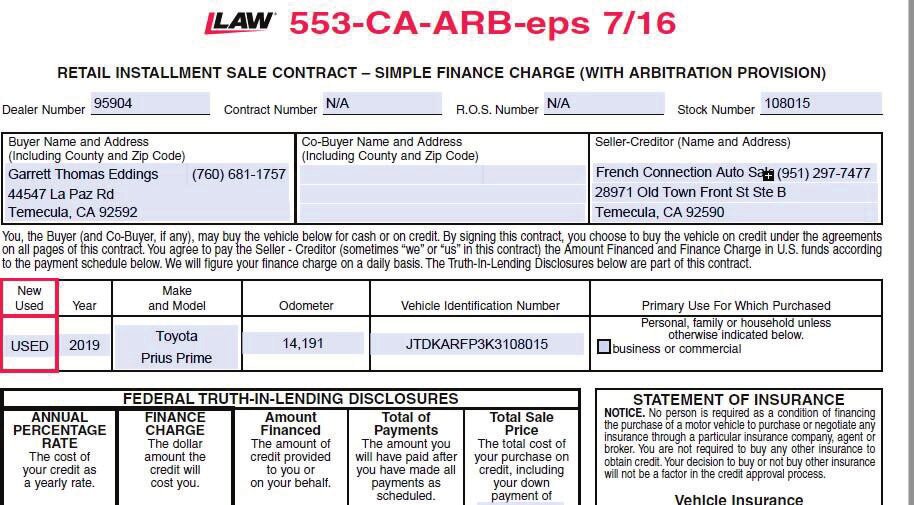
Disclosed on the front portion of the title, the contract needs to have a box outlined in red at least 1 inch squared. Here is the determining factor for a new or used vehicle:
A used vehicle, by definition, is any vehicle that has already been operated and titled.
According to the California Vehicle Code,
“A ‘used vehicle’ is a vehicle that has been sold, or has been registered with the department, or has been sold and operated upon the highways, or has been registered with the appropriate agency of authority, of any other state, District of Columbia, territory or possession of the United States or foreign state, province or country, or unregistered vehicles regularly used or operated as demonstrators in the sales work of a dealer or unregistered vehicles regularly used or operated by a manufacturer in the sales or distribution work of such manufacturer.” (Find Law Staff, 2019)
A new motor vehicle is a vehicle that is sold with a MSO (Manufacturer’s Statement of Origin) or MCO (Manufacturer’s Certificate of Origin)
According to the California Vehicle Code,
“A ‘new vehicle’ is a vehicle constructed entirely from new parts that has never been the subject of a retail sale, or registered with the department, or registered with the appropriate agency or authority of any other state, District of Columbia, territory or possession of the United States, or foreign state, province, or country.” (Find Law Staff, 2019)
Federal Truth-In-Lending Disclosures
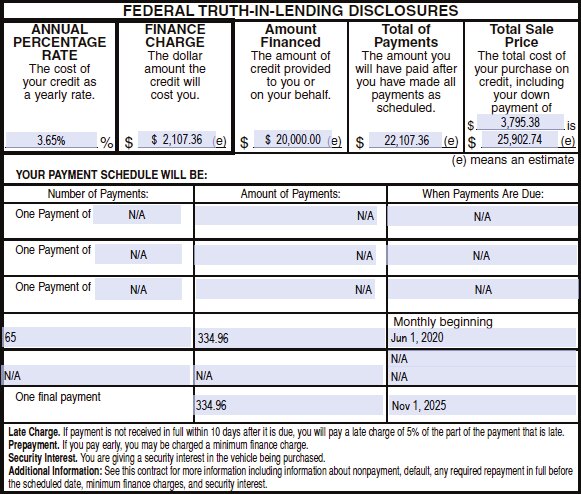
Important elements of the truth in lending disclosures are:
- Annual Percentage Rate
- The cost of the customer’s interest on an annual basis.
- Finance Charge
- The total cost of the credit arrangement.
- Amount Financed
- The amount of money that the creditor will provide to the customer by the financial institution.
- Total Payments
- The combined amount of money a customer will have to pay when all the payments have been satisfied.
- Total Sale Price
- The total cost of the transaction including the customer’s down payment and what the total cost of credit will be.
Breaking out the payment schedule
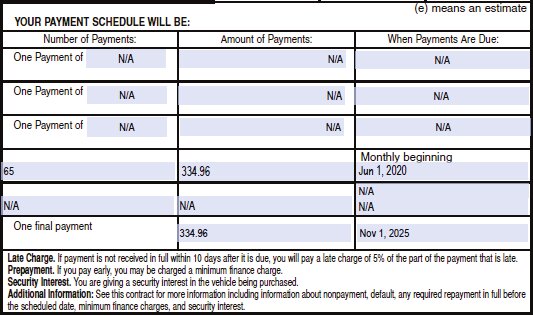
It is important to list out the number of payments, what that total amount of the payment will be and when those payments will be due. It also needs to outline any kind of:
- Late charges – Late charges occur if the monthly payment isn’t paid on time or within the designated grace period, a percentage of the payment will be due to make up for it.
- Pre-payment penalty – It is important to indicate on the contract if there will be any payment for paying the vehicle off early.
- Security Interest and defaults on contract – Customer needs to understand that a lien holder will be added to the title and registration to protect the bank or institution loaning the money. If the consumer defaults on the loan, the vehicle is then leveraged and sold off to go towards satisfying the lien. If the sale doesn’t cover the total due on the loan, the registered owner is still responsible to pay the difference to lien holder.
Dealer Carrying Contract
Beyond the traditional lending practices, dealers can also carry the contract as well. The same disclosures are required, and the dealer must set the same standards, payment schedule and APR as well.
Repossession
Repossession occurs when the customer defaults on a contract and the lender goes through the process of repossession. It is important to note that if a dealer regularly collects debts, or repossesses on a regular basis, the Debt Collectors Licensing Act comes into play for Buy Here Pay Here dealers and finance companies that offer financing to automotive dealers.
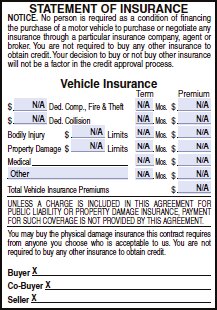
Statement of Insurance
A statement of insurance on a conditional sales contract is a document that outlines the insurance requirements for a vehicle that is being sold on credit. This statement of insurance typically includes information such as the type of insurance required, the amount of coverage needed, and the name of the insurance company.
It is important to include a statement of insurance on a conditional sales contract because it helps protect both the buyer and the dealership in the event of an accident or other incident involving the vehicle. Specifically, it helps ensure that the vehicle is adequately insured so that any damages or losses can be covered by the insurance company, rather than being the responsibility of the buyer or the dealership.
In many cases, the dealership will require the buyer to provide proof of insurance before they can take possession of the vehicle. This helps ensure that the buyer is complying with the insurance requirements outlined in the contract and that the vehicle is adequately protected.
Ultimately, a statement of insurance on a conditional sales contract is an important part of the overall agreement between the buyer and the dealership. By clearly outlining the insurance requirements for the vehicle, it helps ensure that both parties are protected and that there are no misunderstandings or disputes down the line.
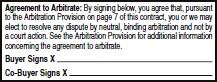
Agreement to Arbitrate
An agreement to arbitrate on a conditional sales contract is a clause that stipulates that any disputes arising from the contract will be resolved through arbitration rather than through the court system. Arbitration is a form of dispute resolution that involves a neutral third party, known as an arbitrator, who listens to both sides of the dispute and makes a final, binding decision.
The agreement to arbitrate is important because it helps provide a faster, more efficient, and less expensive way to resolve disputes between the buyer and the dealership. Rather than going through the court system, which can be time-consuming and costly, arbitration allows both parties to resolve their differences in a more streamlined and informal process.
Another important benefit of an agreement to arbitrate is that it provides more privacy and confidentiality than a court proceeding. Arbitration hearings are typically held in private, and the arbitrator’s decision is not a matter of public record, which can be beneficial for both the buyer and the dealership.
It’s worth noting that while an agreement to arbitrate can be beneficial in many ways, it also has some potential drawbacks. For example, the arbitrator’s decision is final and binding, which means that there is no option to appeal the decision, even if one of the parties feels that the decision was unfair or unreasonable. Additionally, arbitration clauses may limit the buyer’s ability to participate in class action lawsuits, which can be an important tool for consumers in some cases.
Overall, an agreement to arbitrate on a conditional sales contract is an important legal provision that helps provide a more efficient and streamlined way to resolve disputes between the buyer and the dealership. However, it’s important for both parties to carefully consider the potential benefits and drawbacks of this approach before signing the contract.
In this example, the conditional sales contract is broken out over 7 pages, so the page number needs to be indicated in the lower right-hand corner. The customer will also be required to sign and date each page of the conditional sales contract as well.
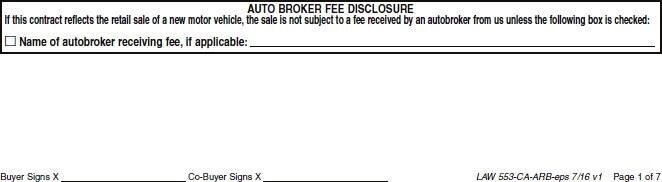
If an Auto Broker is used in the transaction, as we talked about earlier in class, it needs to be disclosed on the face of the contract.
Page 2 of the Conditional Sales Contract
Itemized breakdown of Cost
On the conditional sales contract, every cost needs to be broken down, so it is easy to understand for the customer. Starting with the cash price for the vehicle and accessories without any addons.
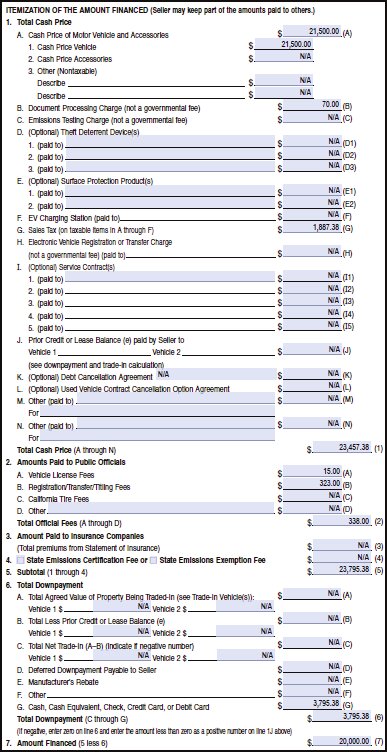
Documentation Fee {Doc Fee}
Doc fees vary across the United States, however in California it is capped at the following breakdown:
- $70 if you are a standard dealership
- $85 if you are a BPA provider (Process registrations at your dealership)
Important to note that a doc fee is optional, but if you charge one customer with a doc fee, you must charge all your customers.
A doc fee is important because it can offset some of the ancillary fees that dealers face with each deal. Some examples of these costs are things like registration services and vehicle history reports etc.
The DMV has not modified their test to correct the true amount so on the DMV test, the correct answer is $50 to pass the test. The doc fees listed above are the correct charges for practical use at your dealership.
Sales tax is broken down as well, we will review later in class how sales tax is calculated.
Then comes the optional products and services for the vehicle are broken out and finalized as a sub total.
Next are the registration fees. Keep in mind that the basic transfer fee for any vehicle is always $15. This will be the minimum amount due. A KSR will be needed to get the exact amount needed for the registration total for the vehicle.
Then the totals are brought down below. Important to remember how much is paid as a down payment and how much is financed. Most DMS programs will break this down for you but in the event the dealer isn’t using a computer, the dealer will have to do the breakdown by hand.
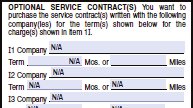
Service Contracts and Debt Cancellation Agreement
An optional service contract and debt cancellation agreement are often listed out on a conditional sales contract for a used vehicle purchase from a car dealer to provide the buyer with additional options for protecting their investment and mitigating risk.
An optional service contract is a type of agreement that can be purchased in addition to the vehicle itself, which provides coverage for certain repairs and maintenance services over a specified period of time. These contracts are often referred to as extended warranties, and they can help provide buyers with peace of mind knowing that certain repairs or maintenance services will be covered if they arise.
A debt cancellation agreement, on the other hand, is an agreement that can be purchased to cancel or forgive the remaining balance on a loan if certain unforeseen events occur, such as the buyer’s death, disability, or involuntary unemployment. This type of agreement can help protect the buyer from the financial burden of repaying a loan in the event of an unexpected hardship.
Including these optional service contract and debt cancellation agreement options on a conditional sales contract for a used vehicle purchase from a car dealer provides buyers with the opportunity to consider additional protection options that may be valuable to them. By including these options in the contract, the dealership can make buyers aware of these options and provide them with the opportunity to purchase them if desired.
Ultimately, these types of optional agreements can help provide buyers with greater peace of mind and protection, and including them on a conditional sales contract is a way to make them more accessible and transparent to buyers.
Trade In Vehicles
Trade-in vehicles are typically listed on a conditional sales contract when buying a used vehicle from a dealer, in order to document the value of the trade-in and how it impacts the overall transaction. This information is important because it affects the final price that the buyer will pay for the vehicle.
When a buyer trades in a vehicle, the value of the trade-in is typically credited toward the purchase price of the new vehicle. The amount of the credit is determined by the value of the trade-in, which is typically assessed by the dealership using industry-standard appraisal methods.
Listing the trade-in vehicle on the conditional sales contract helps ensure that both the buyer and the dealership are in agreement about the value of the trade-in and how it is being credited toward the purchase price of the new vehicle. This information is also important for tax and regulatory purposes, as it helps document the overall value of the transaction.
Additionally, listing the trade-in vehicle on the conditional sales contract can be helpful for the buyer when it comes to financing the purchase. Including the trade-in value as part of the transaction can reduce the amount that the buyer needs to finance, which can help lower the overall cost of the transaction and potentially make it easier to obtain financing.
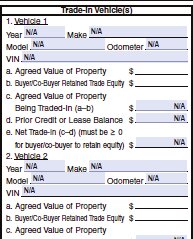
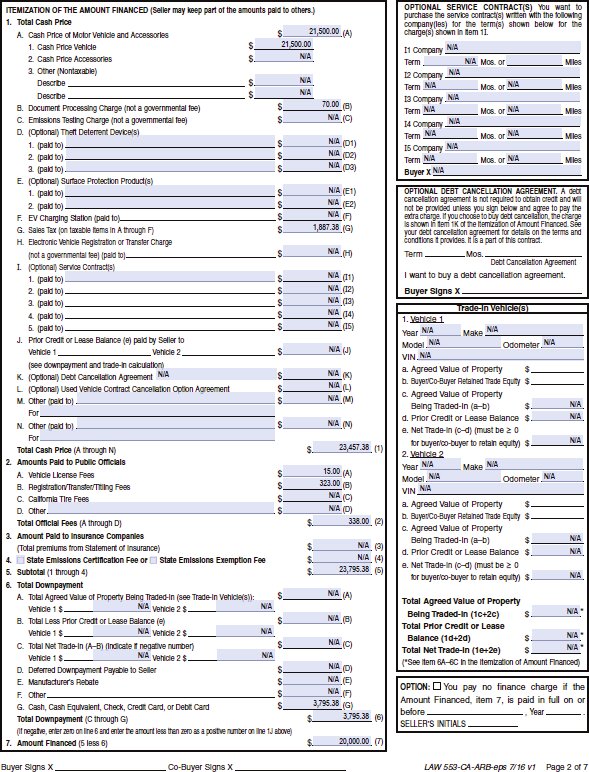
Page 3 of the Conditional Sale Contract
The customer will then read and sign a series of paragraphs which include:
- A trade payoff agreement is a provision that may be included in a conditional sales contract when a buyer is trading in a vehicle that still has an outstanding loan or balance. In this case, the trade payoff agreement specifies that the dealership will pay off the remaining balance on the trade-in vehicle’s loan, up to a certain amount, as part of the overall transaction.
- The trade payoff agreement is important because it helps ensure that the buyer is not held responsible for paying off the remaining balance on the trade-in vehicle’s loan. Instead, the dealership takes on this responsibility, up to the amount specified in the agreement.
- Contract modifications – It’s important to note that any modifications or changes to a conditional sales contract should be made in writing and should be signed by both parties. This helps ensure that both parties are in agreement about the changes and helps protect both parties in the event of a dispute or disagreement. Additionally, any changes to the contract should be made in accordance with any applicable laws and regulations to ensure that they are legally valid.
- Sellers right to cancel – the seller has the right to cancel if financing cannot be obtained. This is a 10-day letter that needs to be sent out and is indicated as a breach of the conditional sales contract.
- All forms of down payment must be returned to the customer in the event the customer cannot get financed.
- Minimum Insurance Requirements – The customer must maintain minimum liability insurance on the vehicle at all times.
Pages 4 through 7 of the Conditional Sales Contract
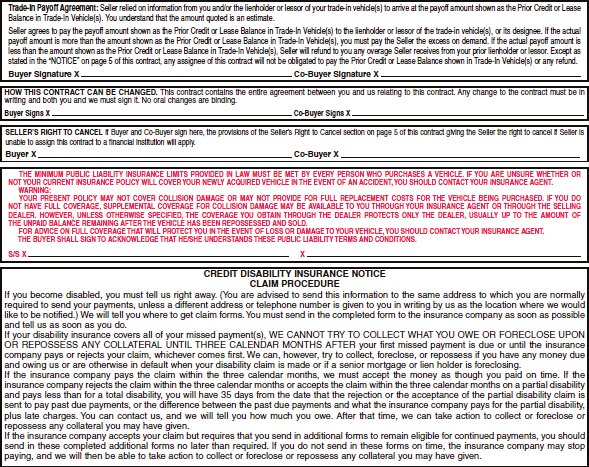
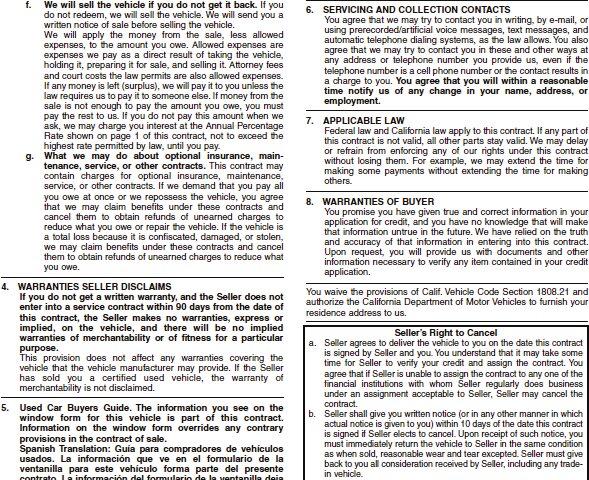
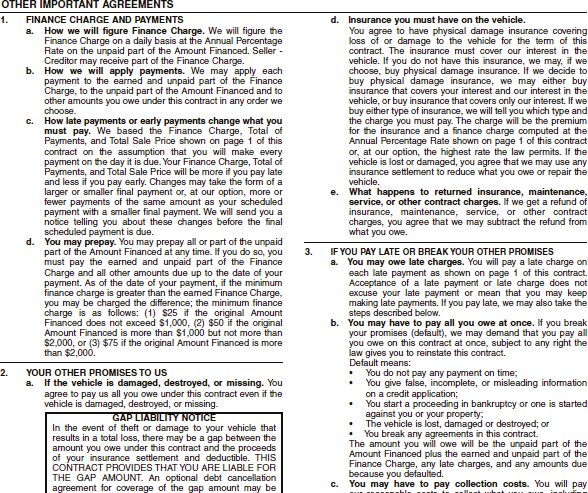
Payment Disclosures and Record Retention (CARS Act)
Two more CARS Act duties round out the paperwork side of a sale. Neither is taught as paperwork today, and both are required.
Written payment proposals
When a dealer makes a written representation about a monthly payment during negotiation for a specific vehicle, the dealer must disclose at least once, clearly and conspicuously in writing, the total amount the consumer will pay at that monthly payment after making all scheduled payments. If the disclosure assumes a down payment or a trade-in value, the amount of that consideration must also be disclosed.
Example: $600 per month for 72 months is $43,200 in scheduled payments. If the proposal assumes $5,000 down, show the $5,000 separately, so the customer can see a combined $48,200.
A written comparison of payment options that talks about lower monthly payments must state that lower monthly payments often increase the total amount the consumer pays. Worksheets, four-square forms, and CRM pencils are not exempt just because they are labeled discussion only.
Record retention
The CARS Act requires records sufficient to show compliance, kept for two years from the date each record is created. That includes total price advertisements and communications, including internet listings that display a price; signed purchase orders and financing or lease documents along with the written communications with anyone who signed; add-on compliance records, including proof the provider was paid on time and the loan-to-value calculations in GAP contracts; cancellation requests with proof of refund and return of the trade-in; and written complaints, add-on inquiries, and inquiries about advertised vehicles along with the dealer’s responses. Customer surveys, reviews, and internet testimonials are not complaints for this purpose. Any legible form is fine, kept the same way as ordinary business records.
Two older rules still apply, which is why the practical answer is to keep a document for the longest period that fits it:
- DMV general rule (13 CCR §272.00 and §272.02): business records kept on site for the first 90 days, then offsite within California and retrievable within 3 business days, for a 3-year total retention period.
- Automobile Sales Finance Act (Civil Code §2984.5): the conditional sale contract and the credit documents behind it, for 7 years or the life of the contract, whichever is longer.
For anything touching a financed sale, that means 7 years, no matter what the CARS Act’s 2-year figure says. Keep the records in whatever form you already use; the Act does not require a particular software or portal.
This is not legal advice. Our content is for educational and marketing purposes only.