Professional Opinion and Disclaimer: This article is based on professional opinion, industry experience, and general education for people interested in California automotive sales and dealership licensing. It is not legal advice, financial advice, tax advice, or compliance advice. California Dealer Academy is not a law firm. If you have specific questions about whether you need a vehicle salesperson license, dealer license, auction access, advertising compliance, background disclosure, or DMV requirements, you should verify directly with California DMV Occupational Licensing and speak with qualified legal counsel when appropriate.
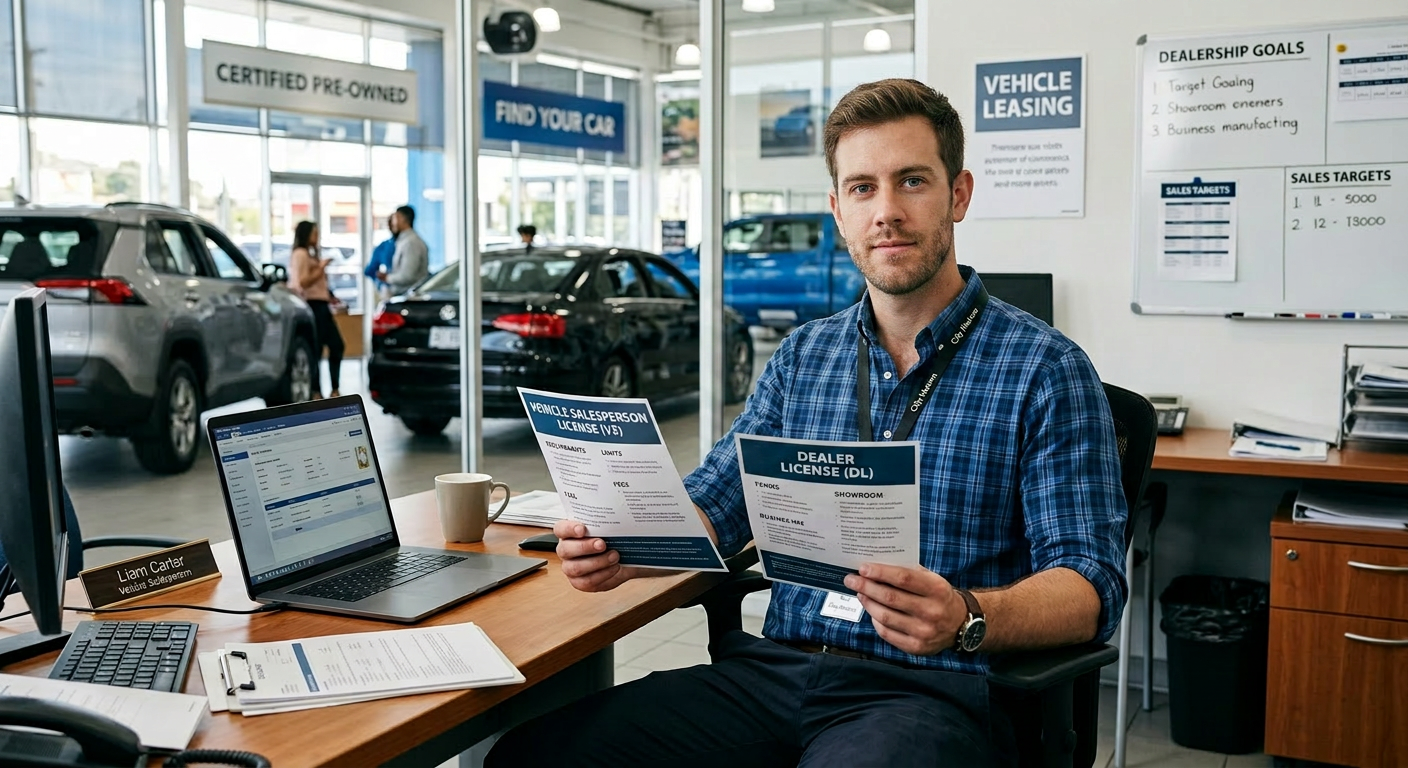
A Car Sales License Is Not the Same as a Dealer License
One of the most common questions people ask is: “Can I get a car sales license so I can buy cars at auction and sell them?”
That question usually comes from a misunderstanding.
A California car sales license, more accurately called a vehicle salesperson license, is different from a dealer license.
A salesperson license is generally for someone who wants to sell vehicles for a licensed dealership. A dealer license is for the business or person operating as the dealer.
That distinction matters.
In my professional opinion, many people search for “car sales license California” because they are looking for a quick way into the car business. Some think it is an auction license. Some think it allows them to buy and sell cars independently. Some think it lets them operate like a dealership without going through the full dealer license process.
That is not the way to look at it.
A salesperson license may allow you to sell vehicles on behalf of a licensed dealership, but it does not make you the dealership. If your goal is to operate independently, buy and sell vehicles for profit, advertise vehicles under your own business, or access dealer-only auctions for your own operation, you are probably looking at the dealer license conversation instead.
This article explains the difference between a vehicle salesperson license and a dealer license, how the California salesperson license process generally works, what applicants should watch for, and why dealer principals should take salesperson licensing and training seriously.
Who Is This Article For?
This article is for several types of readers.
First, it is for someone trying to work at a dealership as a salesperson. If you are applying for a sales job at an independent used car dealership, franchise dealership, or larger automotive group, this article will help you understand what a vehicle salesperson license is and why it matters.
Second, it is for people who are confused between a salesperson license and a dealer license. If you want to sell cars independently, buy vehicles at auction, flip cars as a business, or open your own lot, this article will help clarify why a salesperson license may not be the license you actually need.
Third, it is for dealership owners and dealer principals. A salesperson is not just an employee. A salesperson is a walking, talking extension of the dealership. Their actions, advertising, customer conversations, and promises can affect the dealership’s reputation and compliance position.
What Is a California Vehicle Salesperson License?
A California vehicle salesperson license is an occupational license connected to selling vehicles or vehicle contracts for a licensed dealer.
In plain English, it is the license that allows an individual to work in a salesperson capacity under a licensed dealership.
This may include working for:
- An independent used car dealership
- A franchise dealership
- A larger dealer group
- A licensed dealership that sells vehicles in California
The key phrase is under a licensed dealership.
A salesperson license does not make you the dealer principal. It does not turn you into the dealership. It does not allow you to operate your own dealership independently.
The salesperson is acting on behalf of the licensed dealer.
Car Sales License vs. Dealer License in California
The difference between a salesperson license and a dealer license is one of the most important points in this article.
A vehicle salesperson license is for an individual selling vehicles for a licensed dealership.
A dealer license is for the person, business, or entity operating as the dealership.
| Category | Vehicle Salesperson License | Dealer License |
|---|---|---|
| Who it is for | Individual salesperson | Dealership business or dealer principal |
| Main purpose | Sell vehicles for a licensed dealer | Operate as a licensed dealer |
| Can sell independently? | No, not as a stand-alone dealership | Yes, if properly licensed and compliant |
| Auction access | Not a shortcut to independent auction buying | Dealer auction access may be available depending on licensing and auction rules |
| Business location required? | No dealership location requirement for the salesperson alone | Dealer location requirements apply |
| Dealer bond required? | Not usually for the salesperson license itself | Dealer bond generally required |
| Dealer education/test? | Not the same as dealer license education/testing | Required for many used dealer applicants |
| Relationship | Works under dealership | Operates dealership |
| Biggest misunderstanding | People think it replaces a dealer license | People underestimate the responsibility |
A simple way to explain it: A salesperson license may allow you to sell cars for a licensed dealership. A dealer license allows a properly licensed business to operate as the dealership.
Those are very different things.
What Can You Do With a Car Sales License in California?
In my professional opinion, a car salesperson license allows you to work in a sales capacity for a licensed dealership. That may include helping customers, presenting vehicles, discussing sales terms within dealership policy, and participating in the sales process under the dealership’s license.
The dealership is still the licensed business. The salesperson is representing that dealership.
This is why salesperson conduct matters. When a salesperson speaks to a customer, advertises a vehicle, discusses payments, or makes a promise, the customer may see that salesperson as the dealership.
A salesperson license is not just a personal credential. It connects the salesperson to a regulated business environment.
What Can You Not Do With a Car Sales License?
A vehicle salesperson license should not be treated as a workaround for getting a dealer license.
In my professional opinion, someone should not use a salesperson license to:
- Operate independently as a dealership
- Buy and sell vehicles as their own business
- Use another dealer’s license for personal side activity
- Access auctions for unauthorized personal buying
- Advertise vehicles as if they are an independent dealer
- Represent themselves as the dealer principal
- Sell vehicles from home as a dealership operation
- Avoid the dealer license process
- Act as though the salesperson license replaces a dealer license
A salesperson license is not an auction license. It is not a wholesale license. It is not a shortcut to becoming a dealer.
If your goal is to build your own dealership, then you need to understand the California dealer license path.
Can a Salesperson License Help You Buy Cars at Auction?
This is one of the biggest misconceptions.
Some people believe they can get a salesperson license, connect themselves to a dealership, and then use that status to buy vehicles at auction for themselves.
In my professional opinion, that is dangerous thinking.
Auction access is a serious responsibility. Dealer principals should monitor which salespeople have access to auction platforms and what authority those salespeople have. If a salesperson is tied to a dealership and uses that relationship improperly, it can create problems for the salesperson and potentially for the dealership.
Dealer principals should regularly review access through auction systems, including platforms such as AuctionACCESS, and make sure employees are not using dealership credentials for unauthorized activity.
A salesperson license is not a backdoor into the auction world.
Can You Sell Cars From Home With a Salesperson License?
A salesperson license has nothing to do with operating your own dealership from home.
If you are selling vehicles independently from home, online, through Facebook Marketplace, OfferUp, Craigslist, Instagram, TikTok, your own website, or another platform, you need to be very careful.
If you are acting as a salesperson for a licensed dealership, your advertising should make clear that you are representing that dealership. In my professional opinion, dealer advertising must be handled carefully and should identify the dealership properly.
Vehicle advertisements may need to include dealership information such as the dealership name, location, license information, and other required details depending on the advertisement and situation. Dealers and salespeople should verify current advertising requirements before posting vehicles online.
The key distinction: Advertising vehicles for a licensed dealership is different from selling cars independently as your own business.
If you are trying to run your own vehicle sales operation, you are probably dealing with dealer license questions, not just salesperson license questions.
How to Get a Car Sales License in California
The California vehicle salesperson license process is now more digital than it used to be.
Historically, applicants often dealt with the OL 16 salesperson application in a more paper-driven format. Today, much of the process goes through California DMV Occupational Licensing online.
In general, an applicant should expect to:
- Create or access an account through California DMV Occupational Licensing.
- Complete the vehicle salesperson license application.
- Provide required personal and professional history information.
- Complete the background check process.
- Complete Live Scan fingerprinting using the DMV 8016 form.
- Pay required DMV fees.
- Wait for DMV processing.
- Confirm approval before acting in a licensed salesperson capacity.
Applicants should always verify current steps directly with California DMV because the process can change.
California DMV Occupational Licensing Account
California DMV Occupational Licensing has moved many services online. Applicants can apply, renew, reinstate, or modify certain occupational licenses through DMV’s online occupational licensing system.
For a vehicle salesperson license, this means the applicant should expect to create an online account and complete the required application process digitally.
You are not applying for a dealer license when you apply for a salesperson license. You are applying for an individual occupational license connected to selling vehicles for a licensed dealership.
California DMV OL 16S Salesperson Application
The California DMV salesperson application is currently identified as the Application for Salespersons License (OL 16S).
This application is part of the vehicle salesperson license process. Applicants should complete it accurately and make sure all personal history information is correct.
Common issues include:
- Leaving out prior names
- Not listing name changes
- Not listing maiden names
- Using inconsistent middle names
- Leaving out prior license history
- Not being clear about past employment or professional history
- Entering information that does not match other records
Accuracy matters. Small mistakes can create delays.
DMV 8016 Live Scan for Vehicle Salesperson License
The DMV 8016 is the Request for Live Scan Service form used for DMV occupational licensing fingerprinting.
Applicants should bring the DMV 8016 form to an authorized Live Scan location. Live Scan is the electronic fingerprinting process used for background checks.
Download the DMV 8016 Request for Live Scan Service form.
Applicants should usually expect Live Scan costs to be roughly $50 to $70, depending on the facility and related fees. Applicants should verify the current total cost with the Live Scan provider before going.
A practical tip: before leaving the Live Scan location, make sure the ATI number is clear and accurate. The ATI number is used to track the Live Scan submission. If the number is handwritten poorly, misread, or entered incorrectly into the DMV system, it may create delays.
How Long Does a California Salesperson License Take?
Processing time can vary.
A realistic expectation is often one to four weeks, depending on the background check, application accuracy, DMV workload, and whether there are any issues requiring additional review.
Applicants should not assume instant approval. They should also avoid making employment or income plans based on a guaranteed timeline.
If the applicant has lived in other states, lived outside the country, had prior name changes, or has background issues, processing may take longer.
Is There a DMV Test for a Car Sales License?
A vehicle salesperson license is not the same as a dealer license.
Used dealer applicants may have dealer education and testing requirements, but that is different from the salesperson license process.
There is not the same dealer-style education course or dealer examination requirement for a salesperson license. However, that does not mean salespeople should be untrained.
In my professional opinion, dealerships should invest heavily in salesperson training. A salesperson should understand how to sell, how to communicate with customers, and how to avoid compliance mistakes.
Getting licensed is not the same thing as being trained.
Should a Salesperson Take Dealer Education Anyway?
Even if a salesperson is not applying for a dealer license, dealer-level education can be valuable.
In my professional opinion, salespeople can benefit from learning:
- Basic DMV procedures
- Deal jacket expectations
- Advertising standards
- Customer ID handling
- Vehicle disclosure basics
- Common dealership mistakes
- Sales ethics
- How financing discussions should be handled
- What not to promise customers
- How dealership compliance works
A salesperson who understands dealership compliance is more valuable than someone who only knows how to ask for the sale.
Who Pays for the Salesperson License?
This can depend on the dealership.
Some dealerships may pay for the salesperson license process. Larger dealerships or dealer groups may have a standard onboarding process and may cover some costs.
Other dealerships may require the applicant to pay.
From personal experience, when I was a practicing salesperson, I paid for it myself. In my opinion, if someone is treating car sales as a true profession, paying for their own licensing costs can make sense. Employment can change. If you want to control your own professional path, it may be easier to handle the licensing cost yourself.
That said, each dealership handles onboarding differently.
Is the Salesperson License Tied to a Specific Dealership?
A vehicle salesperson license is connected to the person, but the salesperson operates under a licensed dealership.
If you change dealerships, you should verify what DMV requires for that change or transfer. Do not assume your responsibilities are complete just because you were licensed at a prior dealership.
Before changing jobs, ask the new dealership how they handle salesperson license status, transfers, onboarding, and DMV reporting.
Can a Salesperson Work for Multiple Dealerships?
This is a compliance-sensitive question. Do not assume the answer.
If someone wants to work for multiple dealerships, they should verify current DMV rules, employer policies, and any conflict-of-interest concerns. Dealer principals should also be careful about who represents the dealership and whether that person has obligations to another store.
In the automotive industry, reputation matters. It is a small community. Salespeople should be professional and transparent where appropriate.
Background Checks for California Car Sales Licenses
The vehicle salesperson license process includes a background check.
Applicants with prior misdemeanors, felonies, DUIs, old convictions, or other issues should not assume they are automatically disqualified. But they should also not hide information.
In my professional opinion, honesty is the best approach.
The DMV is going to review background information. If something exists in the record, failing to disclose it properly can create a bigger issue than the original situation.
Should You Disclose Misdemeanors or Felonies?
If the application asks for disclosure, answer honestly.
In my professional opinion, misdemeanors and felonies may need to be disclosed to DMV depending on the question being asked. If you are unsure, contact DMV Occupational Licensing directly or speak with qualified legal counsel.
Do not guess. Do not hide information. Do not assume something is too old to matter unless the DMV instructions say that.
What Background Issues Create the Most Concern?
In my professional opinion, the background issues that may create the most concern are usually those connected to trust, money, vehicles, fraud, DMV activity, or dishonesty.
Examples may include:
- Automotive-related crimes
- Financial crimes
- Fraud-related activity
- Theft-related issues
- DMV-related violations
- Crimes involving dishonesty
- Issues involving titles, contracts, or customer money
- Issues involving misuse of vehicles or dealership resources
A dealership is an environment where employees may be around vehicles, money, titles, contracts, customer information, financing discussions, and DMV paperwork. Because of that, background issues involving fraud, theft, or DMV-related activity can create obvious concern.
That does not always mean the answer is automatically no. It does mean the applicant should be honest and handle the process correctly.
What About DUIs or Traffic Offenses?
Traffic-related offenses may be treated differently than other background issues, but in your professional opinion, a felony DUI is one traffic-related issue that may create concern.
If you have any questions about a DUI, prior conviction, misdemeanor, felony, or other background issue, contact DMV Occupational Licensing directly or speak with qualified legal counsel.
DMV Occupational Licensing Contact Information
Applicants with specific questions should contact California DMV Occupational Licensing.
The DMV’s current public Vehicle Industry Services page lists (877) 563-5213 for Occupational Licensing applicant assistance. Some DMV forms and occupational licensing materials also reference (916) 229-3126 for Occupational Licensing-related questions.
Because DMV contact routing can change, applicants should verify the current phone number on the California DMV website before calling.
Advice for Someone Starting Their First Car Sales Job
If you are starting your first car sales job, treat it like a profession.
Be a sponge.
Watch what successful people do inside the dealership. Find someone who can mentor you. Read sales books. Learn different sales styles. Understand the product. Learn how deals are structured. Learn how customers think. Most importantly, learn how to ask better questions.
Personally, I am a fan of consultative sales. I believe the best salespeople ask questions, gain understanding, and help the customer solve a problem. That approach feels less like the old “used car salesman” stereotype and more like a professional helping someone make an important decision.
A customer may walk in for a vehicle, but they are also evaluating you.
In many cases, the customer is not just buying the car. They are buying you, your credibility, and the way you represent the dealership.
Licensing Is Not the Same as Sales Training
A salesperson license may be required to perform certain sales activities, but the license alone does not make someone a strong salesperson.
A new salesperson should learn:
- Product knowledge
- Sales communication
- How to ask questions
- How to listen
- How to understand customer needs
- How to present inventory
- How to avoid pressure tactics
- How to discuss payments responsibly
- How to avoid overpromising
- How to handle objections
- How to follow up
- How to protect the dealership’s reputation
The best salespeople continue learning.
What Dealer Principals Need to Understand
Dealer principals need to understand that when they hire a salesperson, they are not just hiring someone to move inventory.
They are hiring an extension of the dealership.
That salesperson becomes a walking, talking representation of the owner, the dealership license, the dealership brand, and the customer experience. Anything positive or negative that happens through that salesperson can reflect back on the dealership.
A strong salesperson can build trust, referrals, reviews, and long-term customer relationships.
A poorly trained salesperson can create complaints, bad reviews, compliance issues, and reputational damage.
What Should Dealership Owners Monitor?
In my professional opinion, dealership owners and managers should monitor:
- Advertising
- Social media activity
- Auction access
- Customer communication
- Pricing and payment discussions
- Vehicle representations
- Promises made to customers
- Deal paperwork, where applicable
- Deal jacket completeness
- Customer ID procedures
- Financing statements
- Warranty statements
- Down payment claims
- Credit approval language
- Online marketplace activity
Even if a salesperson does not complete the final paperwork, they may still be involved in customer communication, vehicle presentation, negotiation, ID collection, or initial deal flow.
That means training and oversight still matter.
Why Customer ID Handling Matters
Even basic dealership procedures can matter.
For example, something as simple as taking a copy of a customer’s ID should be done according to dealership policy and current compliance requirements. In your professional opinion, dealership staff should be trained on proper ID collection, copying, storage, and deal jacket procedures.
Small procedural mistakes can create bigger issues later.
Dealer principals should verify current DMV and compliance requirements and make sure their team follows the same process every time.
What Training Should Every Dealership Give New Salespeople?
Every dealership should train salespeople on more than just how to sell.
Training should include:
- Dealership compliance basics
- Advertising standards
- Customer communication
- Deal jacket procedures
- ID handling
- Payment discussions
- Credit approval language
- Warranty language
- Vehicle condition disclosures
- Ethical sales practices
- Product knowledge
- Appraisal basics
- Follow-up process
- Customer-first mindset
- What salespeople should never say
In my professional opinion, salespeople can benefit from dealer-level education or a continuing education-style class, even if they are not applying for a dealer license. Understanding paperwork, compliance, advertising, and common dealership mistakes can make them more professional and help protect the business.
Experienced Salespeople vs. Green Salespeople
Some dealerships prefer experienced salespeople. Others prefer newer or “green” salespeople because they can train them into the dealership’s culture and process from the beginning.
Either approach can work.
The important part is whether the dealership has a clear training system.
An experienced salesperson with bad habits can create problems. A new salesperson with strong mentorship can become a great asset.
The dealership’s leadership, training culture, and sales manager involvement matter.
Hiring Unlicensed or Poorly Trained Salespeople
Hiring unlicensed or poorly trained salespeople can create serious risk.
In my professional opinion, anyone discussing vehicle sales terms, numbers, payments, or contracts with customers should be evaluated carefully to determine whether they need to be properly licensed by DMV.
Allowing unlicensed people to operate in a salesperson capacity may feel like a shortcut, but it can create bigger problems later.
Poorly trained salespeople may:
- Overpromise
- Underdeliver
- Misrepresent vehicles
- Misstate payments
- Misstate approvals
- Misunderstand warranties
- Say whatever is needed to close the deal
- Create customer complaints
- Trigger bad reviews
- Damage the dealership’s reputation
For a small dealership, one poorly handled customer interaction can create real harm.
A Salesperson License Is Not “Just Paperwork”
Some dealership owners treat the salesperson license as something they just need to get done so the salesperson can start working.
That is the wrong mindset.
A salesperson license is part of building a compliant, professional dealership. When you hire a salesperson, you are bringing someone into your business who can affect your customers, your reputation, your reviews, your compliance, and your day-to-day operations.
That deserves more attention than simply checking a box.
Salespeople Who Want to Become Dealers
Many salespeople eventually consider getting their own dealer license.
That is natural. Once you work inside a dealership, you may start to understand how the business works and want to build something of your own.
But becoming a dealer is not just a bigger version of being a salesperson. It comes with additional risk, compliance, capital requirements, location requirements, bond requirements, paperwork requirements, advertising responsibility, tax responsibility, and operational responsibility.
Salespeople should also understand that dealer licensing information may become public record. The automotive industry is a small community. If you are currently working for a dealership while pursuing your own dealer license, be professional, transparent where appropriate, and make sure you understand what you are doing before moving forward.
When Do You Need a Dealer License Instead?
If your goal is to work for a licensed dealership, the salesperson license may be the right topic to research.
If your goal is to operate independently, then you should look at the dealer license path.
You may need to research a dealer license if you want to:
- Buy and sell vehicles as a business
- Operate your own dealership
- Sell vehicles under your own company
- Advertise vehicles independently
- Access dealer auctions for your own inventory
- Open a retail or wholesale dealership
- Build a dealership brand
- Sell vehicles outside an employment relationship with a licensed dealer
A salesperson license is not a substitute for a dealer license.
California Dealer Academy’s Position
California Dealer Academy is primarily known for dealer licensing education, but we also believe in strengthening the dealership community through practical education.
Even when the topic is a salesperson license, the goal is the same: helping people understand the process, avoid confusion, and operate more professionally in California’s automotive industry.
California Dealer Academy does not primarily focus on salesperson licensing the same way it focuses on dealer licensing education. However, we may be able to help someone understand the process, point them in the right direction, or assist with putting application pieces together when appropriate.
If you are unsure whether you need a salesperson license or a dealer license, California Dealer Academy can help you understand the difference.
Frequently Asked Questions About Getting a Car Sales License in California
What is a car sales license in California?
A car sales license in California is commonly referred to as a vehicle salesperson license. It is an occupational license for an individual who sells vehicles or vehicle contracts for a licensed dealer.
In plain English, it is for someone who wants to work as a salesperson at a licensed dealership. It is not the same as a dealer license and should not be treated as a shortcut to operating your own dealership.
Is a California car sales license the same as a dealer license?
No. A California car sales license and a dealer license are not the same thing.
A car sales license is for an individual salesperson working for or under a licensed dealership. A dealer license is for the person or business operating as the dealership.
If you want to work at a dealership, you may be looking for a salesperson license. If you want to own the dealership, buy and sell vehicles independently, or operate under your own business, you are likely looking at the dealer license process.
Can I buy cars at auction with a salesperson license?
A salesperson license should not be viewed as an auction license.
Some salespeople may have auction access through the dealership they work for, but that does not mean they can use that access for their own independent buying and selling activity.
In my professional opinion, dealer principals should carefully monitor auction access and make sure employees are not using dealership credentials for unauthorized activity.
Can I sell cars from home with a car sales license?
A salesperson license is not a license to operate your own dealership from home.
If you are selling vehicles independently from home, online, or through social media as a business, you need to be very careful and should research whether you need a dealer license.
A salesperson license is connected to selling vehicles for a licensed dealership, not creating an independent home-based dealership operation.
Can I sell cars on Facebook Marketplace with a salesperson license?
If you are advertising dealership inventory as a salesperson, you should make clear that you are representing a licensed dealership and follow the dealership’s advertising policies.
If you are advertising vehicles independently as your own business, that is a different issue and may move into dealer license territory.
In my professional opinion, salespeople and dealers should be very careful with Facebook Marketplace, Craigslist, OfferUp, Instagram, TikTok, and other online platforms. Advertising mistakes can create compliance problems.
What is the difference between selling cars for a dealership and being a dealer?
Selling cars for a dealership means you are acting as a salesperson under the dealership’s license.
Being a dealer means you are operating the licensed dealership itself.
The salesperson represents the dealership. The dealer principal or licensed business carries the broader responsibility for dealership operations, compliance, advertising, paperwork, inventory, customer complaints, and DMV obligations.
How do I apply for a vehicle salesperson license in California?
The California DMV salesperson license process generally involves applying through DMV Occupational Licensing, completing the salesperson application, submitting required personal history information, completing Live Scan fingerprinting with the DMV 8016 form, paying applicable fees, and completing the background check process.
Applicants should verify the current process directly with California DMV because forms, fees, and online procedures can change.
What is the DMV OL 16S form?
The OL 16S is the Application for Salespersons License used in the California vehicle salesperson license process.
Applicants should complete the form accurately and make sure all personal information, professional history, prior names, and required disclosures are correct.
What is the DMV 8016 form?
The DMV 8016 is the Request for Live Scan Service form used for DMV occupational licensing fingerprinting.
Applicants take the DMV 8016 form to a Live Scan facility so fingerprints can be submitted for the required background check.
A practical tip: make sure your ATI number is legible and entered correctly. An incorrect ATI number can create delays.
How much does a California car sales license cost?
DMV fees can change, so applicants should verify current costs directly with California DMV.
As of the current DMV fee information, DMV lists the vehicle salesperson license application fee as $51. Live Scan costs are separate and can vary by provider. Applicants should often expect the Live Scan-related cost to be around $50 to $70 depending on the facility and related fees.
How long does it take to get a car sales license in California?
Processing time can vary. A realistic expectation is often one to four weeks.
The timeline can depend on DMV processing, Live Scan/background check timing, application accuracy, prior name history, out-of-state residence history, foreign residence history, and whether there are any background concerns requiring additional review.
Applicants should not rely on a guaranteed timeline.
Do I need Live Scan for a California salesperson license?
Yes, first-time vehicle salesperson license applicants generally need Live Scan fingerprinting as part of the DMV occupational licensing process.
Applicants should bring the DMV 8016 Request for Live Scan Service form to an authorized Live Scan facility.
Do I need to take a test for a California car salesperson license?
A vehicle salesperson license is not the same as a dealer license. The salesperson license process does not involve the same dealer education course and dealer examination required for many used dealer license applicants.
However, salespeople should still be trained. In my professional opinion, dealerships should educate salespeople on compliance, advertising, paperwork basics, vehicle disclosures, customer communication, and ethical sales practices.
Do I need dealer education to get a salesperson license?
Dealer education is associated with the dealer license process, not the same as the vehicle salesperson license process.
That said, a salesperson can still benefit from dealer-level education. Understanding dealership rules, paperwork, advertising, and compliance makes a salesperson more valuable and helps protect the dealership.
Should I get a salesperson license before applying for dealership jobs?
This depends on the dealership.
Some dealerships may help with the process after hiring. Others may expect you to already understand what is required or handle some steps yourself.
If you are serious about car sales as a profession, learning the process before applying can make you more prepared.
Does the dealership pay for the salesperson license?
Some dealerships may pay for the salesperson licensing process. Others may expect the applicant to pay.
It can depend on the size of the dealership and how they handle onboarding.
From a professional standpoint, paying for it yourself can make sense if you are treating car sales as a career and want to own that part of your professional development.
Is a salesperson license tied to one dealership?
The salesperson license is issued to the individual, but the salesperson operates under a licensed dealership.
If you change dealerships, verify current DMV requirements for transfer, modification, or notification. Do not assume everything automatically carries over without action.
Can I work for multiple dealerships with one salesperson license?
This should be verified directly with DMV and the dealerships involved.
Even if something is technically possible, there may be employer policies, conflict-of-interest issues, auction access concerns, and customer confusion concerns.
The automotive industry is small. Salespeople should be careful, professional, and transparent where appropriate.
What happens if I change dealerships?
If you change dealerships, ask the new dealership how they handle salesperson licensing, transfers, or DMV updates.
You should also verify directly with DMV Occupational Licensing so your license status and employment connection are handled correctly.
Can I get a car sales license with a misdemeanor?
A misdemeanor does not necessarily mean you cannot get a salesperson license, but it may need to be disclosed depending on the application questions.
In my professional opinion, honesty is critical. If you have a background concern, disclose what is required, do not hide it, and contact DMV Occupational Licensing or legal counsel if you are unsure.
Can I get a car sales license with a felony?
A felony may create additional review, but applicants should not assume the answer is automatically no.
The best approach is to review the application carefully, disclose honestly where required, and contact DMV Occupational Licensing directly if you have questions about your situation.
Do I have to disclose criminal history on the salesperson license application?
If the application asks for disclosure, answer honestly.
In my professional opinion, failing to disclose required information can create bigger problems than the original issue itself because DMV is already running a background check.
What background issues are most concerning for a dealership job?
From a dealership employment standpoint, issues involving fraud, theft, financial misconduct, DMV-related activity, automotive-related crimes, or dishonesty may create concern because dealership employees may be around money, vehicles, customer information, contracts, titles, and financing discussions.
That does not mean someone is automatically disqualified, but it does mean the issue should be handled honestly and professionally.
Does a DUI prevent someone from getting a car sales license?
A DUI does not automatically mean the same thing in every situation. A felony DUI is more likely to create concern than a minor traffic issue.
Applicants should contact DMV Occupational Licensing or legal counsel if they have questions about how a DUI or traffic-related offense may affect the application.
Should I call DMV Occupational Licensing before applying?
If you are unsure about your background, application answers, prior names, Live Scan status, or salesperson license requirements, contacting DMV Occupational Licensing directly is a good idea.
It is better to ask DMV than rely on assumptions.
What mistakes delay a California salesperson license application?
Common mistakes include leaving out prior names, failing to disclose name changes, omitting maiden names, using inconsistent middle names, leaving out prior history, entering the wrong ATI number from Live Scan, misunderstanding the application, or not checking DMV instructions carefully.
Background checks can also take longer if the applicant has lived in other states or outside the country.
Why does the ATI number matter for Live Scan?
The ATI number helps track the Live Scan submission.
If the ATI number is written unclearly, misread, or entered incorrectly, it can create problems or delays. Applicants should check it carefully before submitting application information.
What should a new car salesperson learn first?
A new salesperson should learn the dealership’s process, inventory, customer communication standards, advertising rules, compliance basics, sales ethics, and how to ask good questions.
The best new salespeople are coachable. Be a sponge, find a mentor, and learn from people who are successful without copying bad habits.
What sales style works best in car sales?
Different salespeople develop different styles, but consultative selling is a strong approach.
Consultative selling focuses on asking questions, understanding the customer’s needs, and helping solve a problem. It feels more professional and less like the negative stereotype of a high-pressure used car salesperson.
What should a car salesperson never say?
A salesperson should avoid making promises they cannot keep.
Be careful with statements about guaranteed approval, payment amounts, down payments, warranty coverage, vehicle condition, prior accidents, financing terms, interest rates, trade-in values, and vague promises such as “we’ll take care of it.”
If it is not accurate, authorized, and documented, do not say it.
Why should dealer principals care about salesperson licensing?
Dealer principals should care because salespeople represent the dealership.
A salesperson’s words, advertisements, customer communication, auction access, and promises can affect the dealership’s reputation and compliance position.
Licensing and training are not just paperwork. They are part of protecting the dealership.
What should dealership owners monitor with salespeople?
Dealership owners should monitor advertising, social media, auction access, customer communication, payment discussions, warranty statements, vehicle disclosures, deal paperwork, ID procedures, and any promises made to customers.
The dealership should have clear policies and training.
What happens if a dealership hires unlicensed salespeople?
Hiring unlicensed salespeople can create serious risk.
In my professional opinion, dealer principals should verify whether anyone discussing vehicle sales terms, pricing, payments, or contracts needs to be licensed before allowing them to work with customers in a salesperson capacity.
Shortcuts in this area can create long-term problems.
Why is salesperson training important?
Salesperson training protects customers, salespeople, and the dealership.
Poorly trained salespeople may overpromise, misstate terms, mishandle customer expectations, create complaints, and damage the dealership’s reputation.
Good training builds professionalism, trust, better reviews, and a stronger dealership culture.
Should salespeople understand dealership compliance?
Yes. Salespeople should understand the basics of dealership compliance even if they are not responsible for every piece of paperwork.
They should know how to advertise properly, communicate accurately, avoid misrepresentations, handle customer information carefully, and avoid making unauthorized promises.
Should a salesperson take a dealer license class?
A salesperson who wants to become a dealer one day should strongly consider dealer education.
Even if they are not applying for a dealer license yet, dealer-level education can help them understand the business, compliance, paperwork, inventory, and risks involved in operating a dealership.
What if I want to become a dealer later?
Many salespeople eventually want to become dealers.
If that is your goal, understand that getting a dealer license is a bigger step. It involves business setup, location requirements, bond requirements, dealer education, DMV application requirements, compliance procedures, and operational risk.
Being a salesperson can be a great learning step, but it is not the same as being ready to operate a dealership.
Is dealer license information public record?
Dealer licensing information may become public record or otherwise discoverable through industry channels. The automotive industry is a small community.
If you are currently working for a dealership while pursuing your own dealer license, be professional and understand how that may be perceived.
Does California Dealer Academy help with salesperson licenses?
California Dealer Academy primarily focuses on dealer licensing education. However, we believe in strengthening the dealership community through education.
If you need help understanding the difference between a salesperson license and a dealer license, or you need direction on the next step, California Dealer Academy may be able to help or point you in the right direction.
When should I take the dealer license course instead?
You should look at the dealer license course if your goal is to operate independently, buy and sell vehicles as a business, open your own dealership, access dealer auctions for your own inventory, or sell under your own business name.
A salesperson license is for working under a licensed dealership. A dealer license is for operating the dealership.
Final Opinion: Treat the Salesperson License Like a Professional Step
A California car salesperson license should not be treated as a shortcut into the car business.
It is not an auction license. It is not a wholesale license. It is not a dealer license. It is not a way to operate independently without becoming a dealer.
It is a license connected to selling vehicles for a licensed dealership.
If you are a new salesperson, treat the role like a profession. Be a sponge. Learn the rules. Find a mentor. Study sales. Understand customers. Represent the dealership well.
If you are a dealer principal, treat salesperson licensing and training as an investment. Your salespeople are an extension of your dealership. They can build your reputation or damage it.
At the end of the day, the customer should remain the focus. A properly trained salesperson creates a better experience, protects the dealership, and helps strengthen the automotive community.
Need a Dealer License Instead?
If your goal is to work at a licensed dealership, the salesperson license may be the right path to understand. But if your goal is to operate independently, buy and sell vehicles for profit, open your own lot, or start your own automotive business, you should look seriously at the California dealer license process. California Dealer Academy helps aspiring dealers understand the process and prepare for the steps required to become licensed.
Call: 888.600.6433 Text: 760.681.1757
Start Your Dealer License Course